









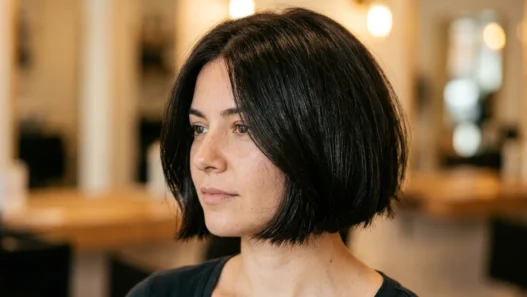

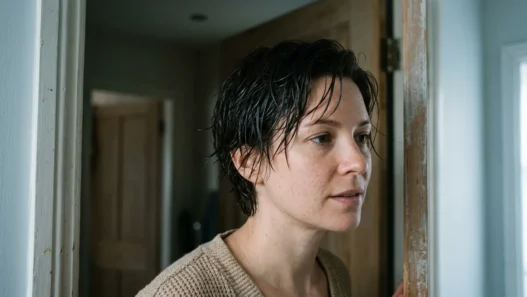
Cuts that work on the morning you have four minutes
I spent eleven years giving people haircuts that only worked when I was the one drying them. This is what I do instead now.
For most of my twenties I was proud of the wrong thing. A client would sit down, I would cut something precise and architectural, spend twenty minutes with a round brush and a nozzle, spin the chair, and she would look wonderful. Then she would go home, wash it, and never get it back. She would return in six weeks a little apologetic, as though the failure were hers, and I would fix it again for an hour and send her out into the same problem.
It took me an embarrassingly long time to hear what people were actually telling me. They were not asking for a different shape. They were asking for a shape that survived them — their four minutes, their thin-bristled brush, their car window down on the drive to work.

Asheville taught me the rest
I moved here from a dry climate, and for the first summer I genuinely thought I had lost my touch. Cuts that behaved perfectly in the chair went home and swelled. Straight hair developed a bend it had never mentioned. Wave turned to frizz somewhere between the salon door and the parking lot.
Humidity is a good teacher because it is not negotiable. You cannot out-product it and you certainly cannot out-blow-dry it. What you can do is cut hair so that the thing it does naturally is the thing you wanted anyway. That is the whole method, and it is less mystical than it sounds: cut it dry, cut it in the direction it already falls, and take weight out of the places that collapse rather than adding layers to the places that do not.
The question I ask first
Before I pick up shears I ask how many minutes you have on an ordinary Tuesday. Not the morning of a wedding — a Tuesday, with the school run or the 8:40 meeting. Most people say five and mean three.
Three minutes is a real constraint and it changes everything downstream. It rules out anything that needs a round brush. It rules out a blunt perimeter on hair that wants to kick. It usually rules out a fringe that has to be dried forward, and it makes a strong case for length that can be tucked when it misbehaves. None of that is a compromise. A cut designed around three minutes is not a lesser cut — it is a cut that has been asked an honest question.
What grows out well matters more than what looks best on day one
Here is the thing nobody puts on a price list. You will wear your haircut for eight or ten weeks, and you will look at it in the mirror something like sixty times. Day one is one of those sixty. Week seven is another, and week seven is when most cuts fall apart — the fringe is in your eyes, the shape has dropped, the graduation that looked so sharp has grown into a shelf.
So I cut for week seven. Sometimes that means leaving a cut slightly less finished than it could be, because the version that peaks on day one is the version that has nowhere to go. A shape with no awkward stage is worth more than a shape that photographs beautifully the afternoon you get it.
Why I write this down
Most of what is written about haircuts is written about the appointment. The photographs are all day-one photographs, taken under salon lights by the person who just did the styling. That is a fine way to sell a cut and a poor way to choose one.
What I want this site to be is the other half of the conversation: which shapes actually air-dry, which ones need the heat, what a cut looks like in week seven, and what to ask for so you get the version that suits your mornings rather than the version that suits the photograph. I will tell you when a cut is more work than it looks, because that is usually the part left out.
None of this is about doing less because you care less. Half my clients are the most put-together people I know. It is about spending the effort where it shows and getting it back everywhere else.
Want to reach me?
If something here does not match the hair you actually have, tell me — that gap is usually the interesting part, and it is often what I write about next. You can find me on Pinterest or send a direct message through the contact page.
Business and collaboration inquiries go to [email protected].
— Maeve — Maeve