











I used to tell clients they just needed the right product. That was wrong — embarrassingly wrong — and I said it for years before I finally figured out what was actually going on. The morning routine doesn’t start at the bathroom mirror. It starts six weeks earlier, in the chair. And most women never hear that part.
The Appointment That Changed How I Think
She came in on a Tuesday. Dark wavy hair, dense, sat just past her shoulders in a kind of defeated middle-length that wasn’t doing anything for anyone. She said she wanted something easy. She’d been saying that to every stylist for probably four years. What she’d been getting back was a trim, a few layers, and the same instruction to use a diffuser and a curl cream. She didn’t want to use a diffuser. She wanted to wash her hair, go to work, and not think about it again until Thursday.
That’s when I realised I’d been solving the wrong problem. I’d been adding products and tools into a shape that fundamentally needed tools to survive. The cut itself was asking too much of her.

A genuinely low maintenance haircut isn’t shorter, or simpler, or more trendy. It’s a shape that behaves when it dries without help. That’s the whole mechanism. And building that shape looks different on wavy hair than it does on straight hair, different on fine hair than thick, different at the collarbone than at the jaw. Getting this right is why I think most women end up disappointed — the cut they asked for looked great in the salon and fell apart by day two at home.
What the Cut Actually Needs to Do
Here’s the mechanism, and it’s not complicated once you see it. A low maintenance haircut has to hold a recognisable shape as the hair dries — without you redirecting it. That means the internal weight distribution has to match your hair’s natural movement. Fighting that movement is what requires product. Working with it is what creates an effortless result.
For straight, fine hair, this usually means a blunt or very lightly layered cut that preserves weight at the ends — something with perimeter density so the shape doesn’t collapse. For wavy or frizz-prone hair, it means removing bulk from underneath rather than chopping length, so the wave can actually form without poofing outward. For thick hair, it means internal thinning that lets the hair fall rather than sit, because a heavy blunt cut on thick hair air-dries as a triangle.

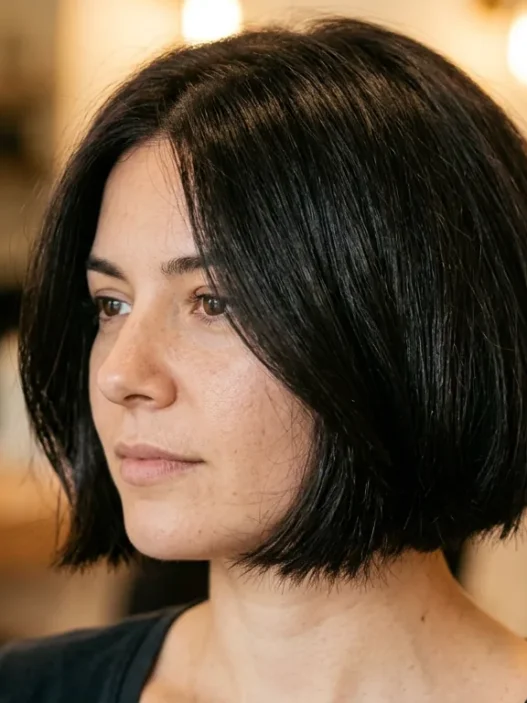
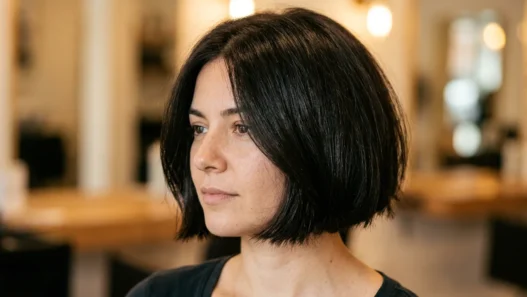
I find that the most consistently effortless cuts — the ones women come back raving about — land somewhere between the chin and the collarbone. Look at how the hair falls on her in that image. That length allows enough weight to pull the shape down, but not so much hair that drying takes forever. She’s wearing it completely unstyled and it still looks intentional. That’s the goal. For a deeper look at how shorter options behave on different face shapes, I wrote more about hairstyles for short hair and what nobody tells you — some of those principles apply at medium lengths too.
The cut also needs to account for how your hair grows. A style that looks perfect at week two but needs a trim by week four isn’t low maintenance — it’s just a shorter salon schedule in disguise. A properly thought-out shape grows gracefully, and that’s something you can feel by week seven.
What Week Seven Tells You
Week seven is my personal benchmark. It’s far enough past a fresh cut that the precision has softened, the shape has grown out, and you can really see what the underlying structure is doing. If a client texts me at week seven saying she loves it, I know I got the architecture right. If she’s miserable, something in the original plan didn’t work — and it’s usually one of three things.
First: the layers were placed for how the hair looks freshly blown out, not how it behaves air-dried. These are completely different things, and most cuts are designed around the former. Second: there’s too much graduation or too many disconnected pieces that start falling in different directions as growth adds weight. Third — and this is the one that frustrates me most — the cut was copied from someone with completely different hair texture. A soft shag that lives effortlessly on medium-thick wavy hair becomes a full-time job on fine straight hair.

Week seven is also where you learn your maintenance ceiling. Some women are genuinely fine stretching to twelve weeks between cuts. Others find eight weeks is the absolute limit before the shape loses coherence. Knowing your ceiling matters, because a cut that requires trims every six weeks isn’t low effort — even if it looks simple.
The honest truth is that understanding haircut choice by texture before you sit in the chair saves you months of trial and error. Most stylists — myself included, early on — will cut what the client asks for rather than what will actually serve their texture. You need to be able to articulate what your hair does, not just what you want it to do.
What I Changed My Mind About
I used to think short hair was automatically easier. I believed this completely. Clients would ask about going shorter and I’d enthusiastically agree that yes, a pixie or a cropped cut would simplify their lives. I was wrong about this more often than I was right.
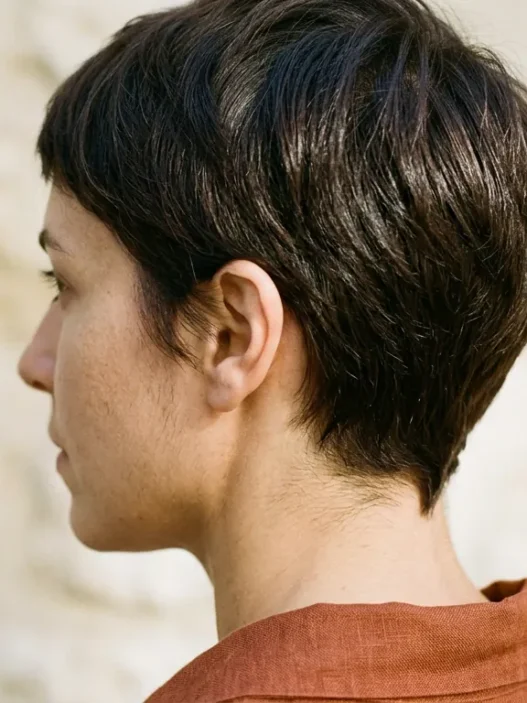
Here’s my actual opinion: very short cuts are only low maintenance if your hair does what a short cut needs it to do without interference. For a lot of women — especially those with natural volume, wave, or cowlicks — a cropped cut requires more daily attention than a collarbone-length shape that can be left alone. The pixie that looks effortless on someone with fine, straight, cooperative hair is a 20-minute styling exercise every morning for someone with growth patterns that push in the wrong direction.
I still love a well-executed pixie. The pixie cuts for fine hair conversation is one worth having — because fine hair is genuinely one of the few types where a cropped cut can be genuinely low effort. But I don’t recommend short as a default answer to the “I want something easy” request anymore. Sometimes the most effortless thing is more length, not less. That’s probably a controversial thing to say in a beauty context, and I’ll stand by it.
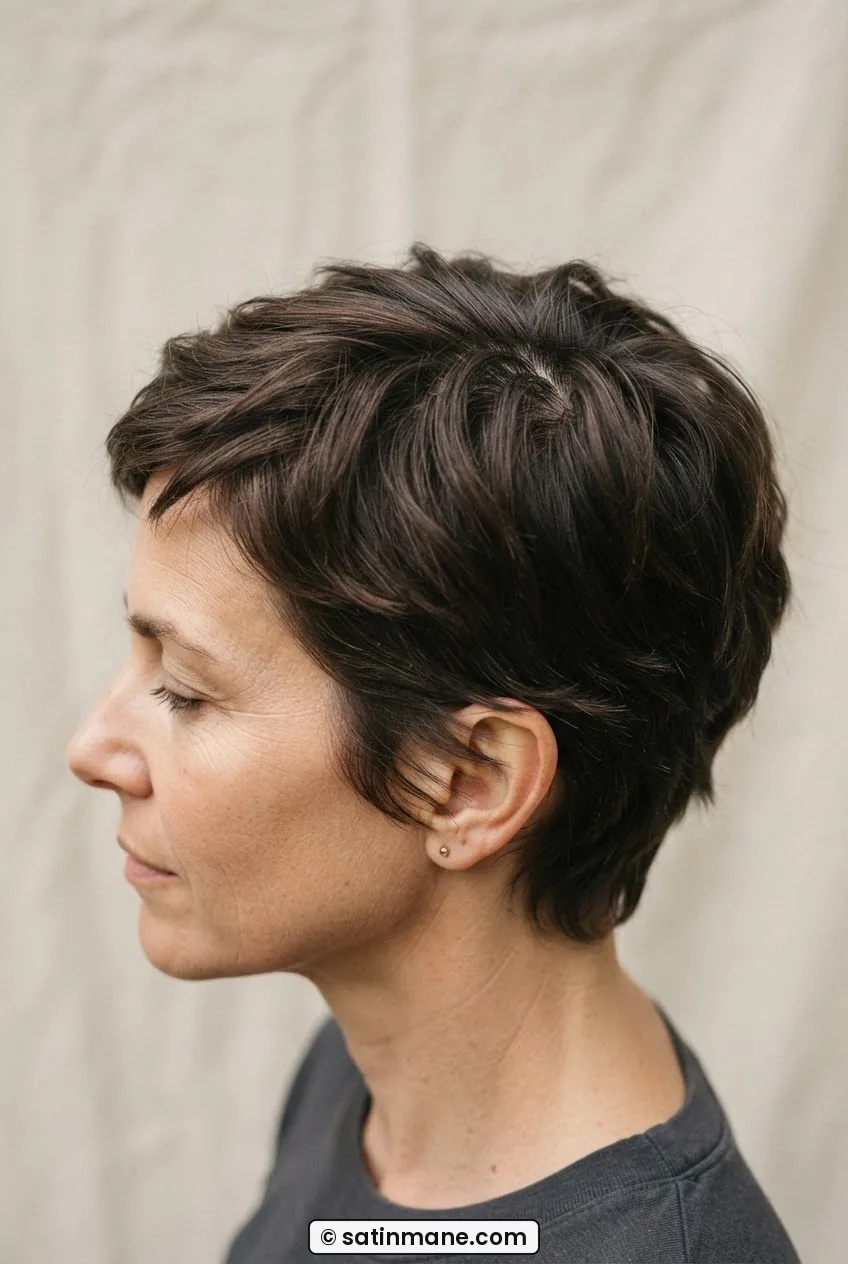
I also changed my mind about layers as a universal solution. For a long time I layered everything. Layers felt like a way of giving the hair movement and life. And they can — but heavy layering on fine hair removes the density that makes the shape look intentional. A blunt or barely-layered collarbone cut on fine hair often looks better and requires dramatically less effort than the heavily layered version that a magazine would tell you adds “body.” That particular piece of advice has done a lot of damage to a lot of haircuts.
If you’re in the thicker-hair category and struggling, the short cuts category on this site has some options worth looking at — but I’d filter by texture and read what’s actually being said about each shape, not just the look of it.
The Face Shape Conversation We Should Have
I know, I know. Face shape advice has been beaten to death. Round face gets elongating cuts; square face gets soft layers; oval face can wear anything. You’ve read this before. But there’s a version of this conversation that’s actually useful, so let me try to have it differently.
The honest intersection of face shape and low maintenance isn’t about what flatters you most — it’s about what flatters you without styling. Because a beautifully structured chin-length bob can be incredibly flattering on a round face when blow-dried and smoothed, and completely shapeless when air-dried and left. If your hair has to be styled to deliver the face-framing benefit, it doesn’t qualify as low maintenance regardless of the theory behind it.
For round faces specifically, I think the most genuinely effortless option is a collarbone-length or longer cut where the weight of the hair naturally creates some vertical pull. Not a jaw-grazing bob that requires straightening to elongate. If you want something shorter, read the real version of short haircuts for round faces — because the “what works” list is shorter than you’d expect when you factor in air-drying.

For women over 50, there’s an additional texture factor: the hair often becomes finer or more wiry, cowlicks become more pronounced, and growth slows. The cuts that worked at 35 genuinely might not behave the same way now. I’ve seen clients come in bewildered that a style they’ve worn for a decade suddenly seems unruly — and it’s not them, it’s the texture shift. A good look at what actually works in terms of short haircuts for women over 50 starts with understanding that shift, not ignoring it.
The face shape rules I do stand behind: avoid cuts that create bulk at the widest point of your face. Beyond that, the most important question isn’t “what shape is my face” — it’s “what does my hair do when it dries.” That tells you far more. Reading up on face shape and haircut guides can help you narrow your options, but texture always wins the argument.
Questions I Get About This
Is there a cut that works on literally any hair type?
Not one specific style, no. But the collarbone-length, lightly structured cut comes closest to a universal option — because the length gives the hair enough weight to behave, and the styling pressure is lower than both very short and very long cuts. It won’t be perfect for every texture, but it’s the nearest thing to a safe starting point I’ve found. Medium haircuts for every texture can give you a more detailed breakdown by type if you want to get specific before your appointment.
How do I explain what I want to my stylist?
Tell them what you do in the morning, not what you want it to look like. Specifically: do you blow-dry or air-dry, do you use any product, and how many minutes do you realistically spend on your hair before leaving the house. That information is more useful to a stylist than a photo, because it tells us what the cut has to do on its own.
How often does a low maintenance cut actually need trimming?
Honestly, it depends on the shape more than the length. A very precise cut — a blunt bob, a geometric shape — needs a trim every six to eight weeks to stay sharp, even if it’s technically simple. A softer, slightly grown-out shape can last ten to twelve weeks without losing its coherence. If a stylist tells you to come back in four weeks, that’s a flag that the cut might not be as low maintenance as advertised.
Can I make my current cut more effortless without starting over?
Sometimes, yes. If the problem is bulk causing your hair to dry in an unflattering shape, a stylist can adjust the internal weight without changing the overall length or style significantly. But if the issue is the fundamental silhouette — the shape genuinely requires tools to look right — that’s harder to fix without going back to the drawing board. Worth having an honest conversation with your stylist about what’s actually causing the morning struggle.
The woman with the wavy hair, by the way, left with a collarbone-length cut with all the bulk removed from underneath and a softly blunt perimeter. She texted me at week nine. She said she’d been washing her hair, shaking it out, and leaving the house. That’s it. That’s the whole thing. The right low maintenance haircut isn’t a magic trick — it’s just a shape that respects what your hair actually does.