








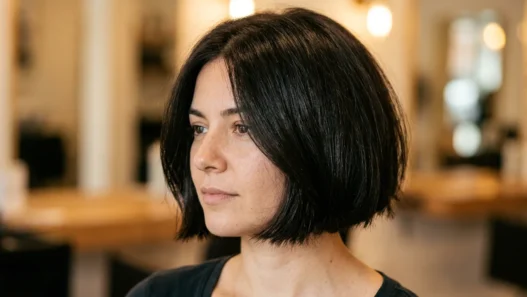




She came in on a Tuesday, which is usually my quietest day. She had a ponytail in — not a styled one, just hair that had been bundled up so it would stop being a problem. I’ve seen that look a thousand times. It’s the look of someone who gave up not on their hair, but on the time required to deal with it.
What happened in that appointment is basically the whole argument for getting your cut right before anything else. Not the product. Not the routine. The shape.
She Sat Down and Said Nothing
That’s not a complaint. Some clients talk through the whole thing. She just sat, took the elastic out of her hair, and let it fall. Shoulder-length, wavy — genuinely wavy, the kind that isn’t quite curl and isn’t quite wave, it’s just whatever the weather decides. She looked at herself in the mirror and sighed. Not dramatically. Just a small, tired sigh.
“I just want something I don’t have to think about,” she said finally. And then, almost in the same breath: “But I don’t want to look like I don’t think about it.”
That sentence is actually the whole problem with how people search for lazy hairstyles. They imagine lazy means effortless output with zero input. But effortless output requires enormous input — it just happens at the salon, not in your bathroom at 7am. The cut does the work. You just wash it.
She had been managing her hair for years with dry shampoo and avoidance. Her ends were uneven — not from a bad cut, but from no cut for about eight months. The shape had just… dissolved. Hair does that. It grows out into whatever it wants to be unless you give it a framework to grow into.
What I Noticed Before I Even Picked Up the Scissors
Her wave pattern. That’s the first thing. With any client who wants genuinely low-effort hair, I spend more time looking than most people expect. Because if the cut fights the natural texture, you will spend every single morning fighting it too. And that’s the opposite of what she was asking for.
Her waves were loose — roughly a 2B if you follow the honest version of the low-maintenance haircut typing systems — with a bit more movement at the roots and flatter through the mid-lengths. Classic case of hair that looks great wet and then dries into something undefined. The problem wasn’t her texture. The problem was that her length and her layers weren’t helping her texture do anything useful.
I also noticed her face shape. Oval, with a slightly wider forehead than she probably realised. Not something that needs “correcting” — that’s an outdated way to think about it — but something that tells me where weight in the cut can sit beautifully and where it’ll just make everything look heavy. Weight at the jaw on her would anchor the face. Weight at the ears would balloon it outward. Details that change which version of “wavy bob” you actually cut.

I asked her how she dried her hair. “Air dry, mostly. Sometimes I diffuse if I’m going somewhere.” Perfect. That confirmed everything. She wasn’t someone who was going to pick up a round brush and blow out her waves into submission — and she shouldn’t have to. The cut needed to work with air drying, full stop. If you want to understand what cuts genuinely survive that process, the breakdown on bobs with nothing to maintain is the most honest place to start.
What I Cut First — and Why It Changed Everything
The length. Not dramatically — about an inch and a half. But I took it to just below the jaw rather than sitting at shoulder, because on wavy hair, shoulder length is the cruelest place to land. The wave hits the shoulder, gets confused, and flips outward. You end up with a mushroom. Below the jaw or above it entirely, and the wave knows what to do.
Then — and this is the part most people skip — I cut into the ends rather than across them. Point cutting, some texturising through the mid-lengths. Soft, not aggressive. With wavy hair you want the ends to feel light enough that the wave can finish its journey. Heavy blunt ends on a wave pattern just drag everything down. I see this mistake constantly, even from good cutters who do it out of habit.

No dramatic layers. This is my slightly controversial opinion and I’ll stand by it: for lazy hairstyles on wavy or curly hair, a lot of layers is often the wrong answer. Lots of layers need lots of maintenance. They need to be refreshed, they need styling to look intentional, and if your curl pattern isn’t consistent throughout — which most people’s isn’t — too many layers creates chaos rather than movement. A soft, minimal layer through the mid-length and a lightly disconnected piece framing the face. That’s it. Let the texture carry it.
For anyone whose texture is fine or straight rather than wavy, the calculation changes completely. The cuts that survive a four-minute morning for fine hair are a different conversation — more about weight and volume than about wave management. But the underlying principle is the same: the cut has to do the work, or the morning will.
A Diffusing Technique That Actually Makes Sense
The Moment She Stopped Apologising for Her Hair
It happened mid-blow-dry. I was diffusing on low heat, scrunching upward, and she watched in the mirror with an expression I can only describe as suspicious optimism. Like she’d been promised this before.
“Why does it look like that when I do it?” she asked.
And I had to be honest with her. Part of it is technique — the way you distribute the product, whether you scrunch before or after the diffuser, whether you touch it while it’s drying. You can read up on diffusing wavy hair and it’ll genuinely help. But a bigger part of it was simply that the shape we’d just created allowed her waves to clump and define instead of fighting a length that was working against them.
She stopped apologising sometime around that moment. I noticed it because the small commentary about how her hair “never does what it’s supposed to” just… stopped. She was watching it do what it was supposed to. Finally.

“Wash and go doesn’t mean skip everything. It means you did the thinking in advance, at the salon, so you don’t have to do it at 7am.”
That’s genuinely what I believe. The whole idea of lazy hairstyles is front-loaded effort. You invest in a good cut — maybe every eight to ten weeks rather than letting six months go — and the return is every single morning between appointments. That’s not laziness. That’s efficiency.
What She Saw When She Left
She stood up, turned her head side to side, and said: “I look like I tried.”
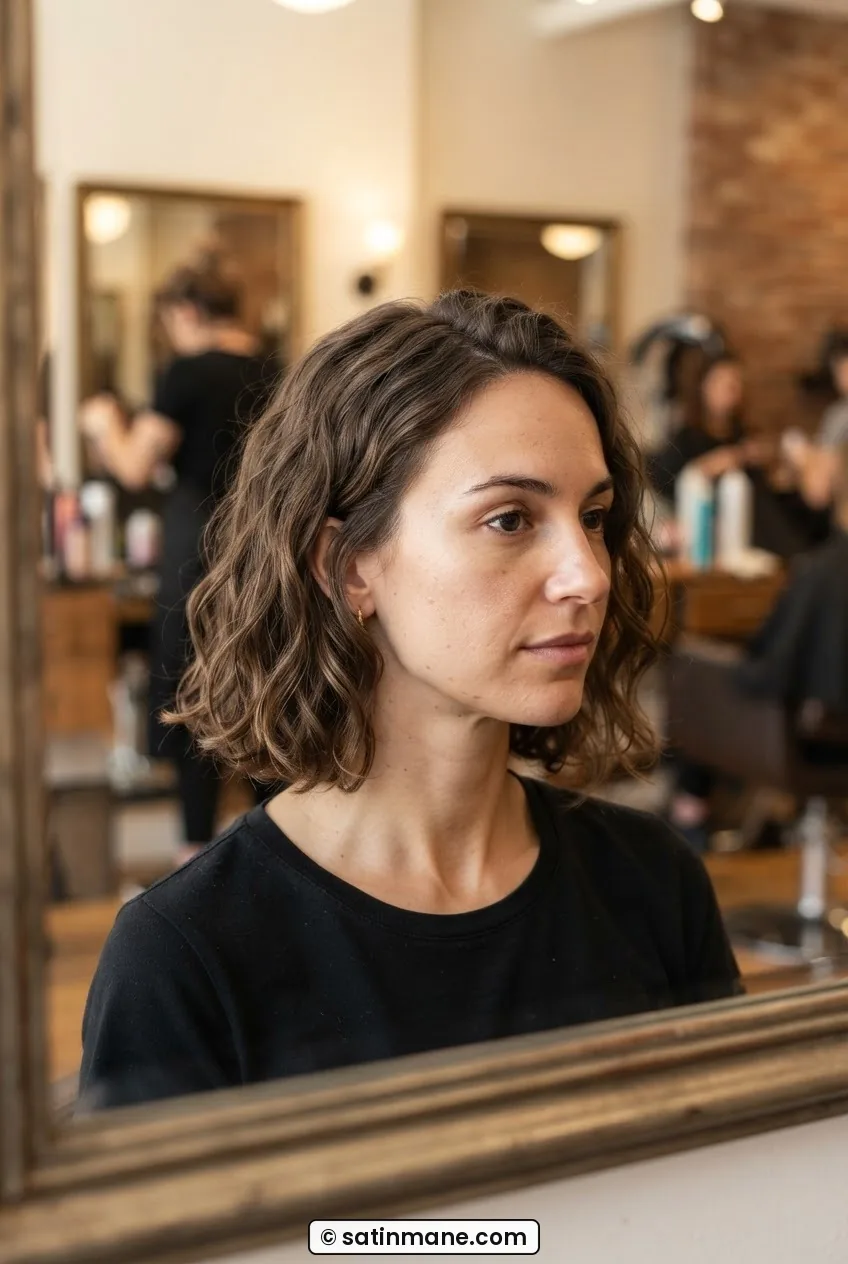
Which was exactly the point. Look at how the wave falls on her — that’s the thing I want you to notice in the photo above. It’s not a styled look. It’s not a blowout or a curl pattern set with product. It’s what her hair does when you get out of its way. That soft, natural movement settling at the jaw? That’s not technique. That’s a well-shaped cut on the right texture finding its own form.
She asked me what to do at home. I kept it short: a lightweight curl cream, scrunch it in on soaking-wet hair, don’t touch it while it dries. That’s all. No five-step routine. No styling tools required. The whole point of this cut was that it should survive being completely ignored after washing — and it does.

What this appointment taught me — or rather, reminded me, because I know it and sometimes forget to say it clearly enough — is that the clients who struggle most with their hair are almost never doing something wrong in their routine. They’re managing a cut that isn’t designed for their texture or their lifestyle. If you’ve ever pulled your hair into a style that nobody tells you the truth about and thought “why can’t I make this work,” the answer is probably in the shape, not you.
And if you’re currently in that particular purgatory of growing something out, trying to survive the stages — there are cuts that hold a shape while you wait. The guide to hairstyles for growing out a pixie is written for exactly that in-between frustration, and most of the logic applies to growing out any short cut, not just pixies.
She tipped generously, which I mention not to brag but because it always surprises people — sometimes the biggest transformations are the quietest ones. No colour, no dramatic length change. Just a cut that finally agreed with the hair it was on. She looked good because she looked like herself, effortlessly. That’s the goal every single time. You can also read more about low-maintenance cuts for wavy hair if you want to go deeper on texture-led cutting before your next appointment.

The Lazy Hairstyle Questions I Get Every Week
Is a wash-and-go really possible for curly hair, or does it always need product?
Product helps, but it’s not the foundation — the cut is. A well-shaped curly cut will clump and define on its own even with minimal product. That said, a lightweight gel or cream on soaking-wet hair seals the cuticle and massively reduces frizz, which makes the whole thing look more intentional. Think of product as the finish, not the structure.
How often does a low-maintenance cut actually need trimming?
Every eight to ten weeks for most cuts — more often than people expect, ironically. The reason low-maintenance cuts feel effortless is that their shape is precise. Let the shape dissolve and you’re back to managing a haircut that doesn’t know what it’s doing. Think of regular trims as the maintenance that replaces the daily styling, not an addition to it.
What if my hair is fine and wavy — does wash-and-go still work?
Yes, but the cut has to be lighter. Heavy layers on fine wavy hair go flat by midday — the wave has no substance to hold them up. A jaw-length or collarbone cut with minimal internal layering keeps the movement without the weight loss. Diffusing rather than air drying also helps fine hair enormously — it adds volume as the wave sets rather than letting gravity flatten it.
Does face shape actually matter when choosing a lazy hairstyle?
It matters less than the hair type, but it’s not irrelevant. Where the cut ends — at the chin, the jaw, the collarbone — changes what’s emphasised on the face. For a lazy cut that still looks shaped and deliberate, landing the length at or just below the jaw tends to work across most face shapes because it creates a natural frame. The extremes (just above the ear, or past the collarbone) are where face shape starts to matter more.
Can I ask my stylist specifically for a lazy hairstyle — will they know what I mean?
You can, but be more specific. Say “I air dry and don’t own a round brush” and “I want to wash it and leave it.” That tells a stylist exactly what the cut needs to do. “Low maintenance” means different things to different people — to some it means a pixie, to others it means long hair you never have to style. Describe your morning routine (or lack of one), not the aesthetic you want.
She messaged me three weeks later — just a photo. Hair dried, no styling. It looked exactly as it did when she left. That’s the whole thing, really.