











Fine wavy hair sits in this awkward middle ground where you have just enough texture to want to show it off, but not quite enough density to pull off the cuts made for thick, bouncy spirals. I’ve spent years figuring out which shapes actually serve the wave instead of flattening it — and the answer almost always comes down to where the weight sits and how much bulk gets left in.
These nine cuts are organized by pattern, from the loosest bend through to defined S-waves and the chaotic beauty of carrying two different textures on one head. If you know roughly where your hair falls on that spectrum, you’ll find your answer faster.
Wave Patterns & The Cuts That Fit Them
1. A Loose Bend at the Collarbone
This is the shape I recommend most often to anyone with fine wavy hair who’s not sure where to start. The collarbone length gives the wave room to actually form — too short and a loose bend disappears into frizz, too long and the weight of fine hair drags it flat. Right at the collarbone, it hits the sweet spot.
The key is asking for long, soft layers through the mid-shaft only. No layers near the ends — a clean perimeter gives the bend somewhere to turn. Think of it less as a cut and more as a frame for the movement your hair already has. You can read more about how mid-length layering on fine hair can go wrong if the layers start too high — this cut avoids exactly that mistake.

2. A Slight Bend, Chin-Length
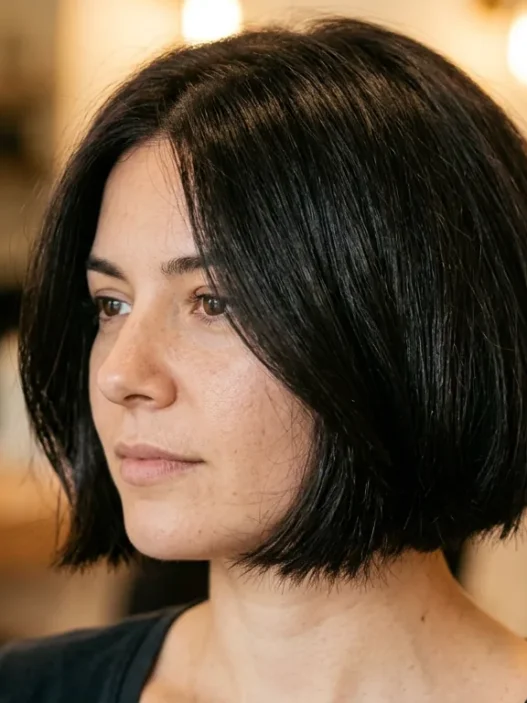
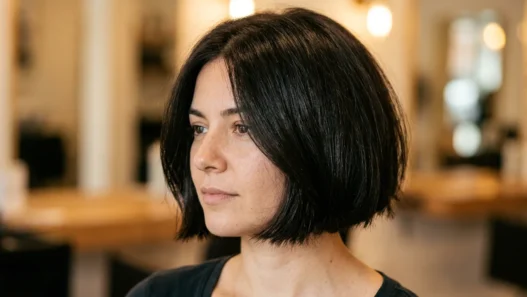
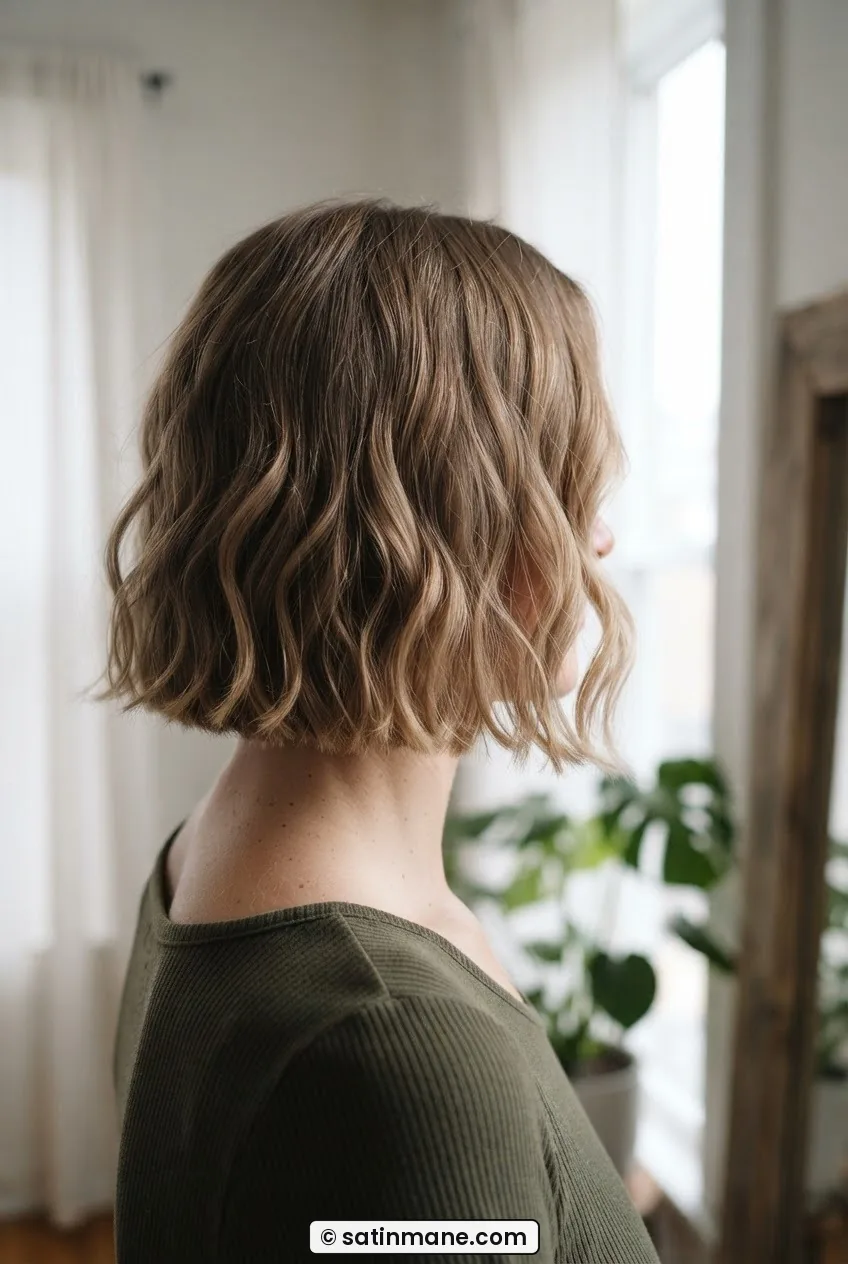
The chin-length bob for a barely-there wave. This one works because the bob’s perimeter weight actually helps the bend look intentional rather than accidental. Without that weight, a loose wave at chin length can read as “didn’t quite dry properly.” With it, the same bend reads as movement.
Go graduated at the back — tighter at the nape, longer toward the face. That internal shape pushes volume where fine hair needs it most: around the crown and cheekbones. The front pieces can be slightly longer to create a soft angle. I’ve seen this work on faces that had previously written off bobs entirely because every previous version felt flat. The graduation changes everything. If you’re curious about other bob hairstyles built specifically for fine hair, that page has nine worth looking at.

3. A Soft Curtain Fringe on a Loose Wave
A curtain fringe on fine wavy hair is either a revelation or a disaster, and the difference is almost entirely about how it’s cut. Thick, blunt fringe on fine hair just droops. But a feathered curtain — long pieces, tapered thin at the very ends, parted in the middle and swept to each side — moves with the wave instead of fighting it.
When air-dried, the fringe gets a soft bend at the ends that mirrors the rest of the hair’s movement. Look at how she’s wearing hers in this photo — that slight curl at the tip of the fringe is the whole point. It’s not a styled look. That’s just what happens when fine wavy hair is cut right and left alone.
Keep the rest of the cut simple if you’re adding a fringe. A collarbone length or a long bob gives the fringe space to be the detail without competing with too many other elements.

4. A Proper S Through the Lengths
When the wave pattern is a real S — not just a bend, but an actual back-and-forth through the length — the hair has enough texture to carry a long shag. And a long shag on fine wavy hair is one of my favorite things in haircut-world.
My personal pick for fine wavy hair that has a real S pattern is a long shag with curtain layers — cut to shoulder length, with the layers starting at the cheekbones and cascading down. It looks like it took effort. It took nothing. Air-dry, shake, done.
The shag’s layers remove the weight that would otherwise drag fine hair flat, while leaving enough length for the wave to complete its full S before the ends. The result is defined-looking wavy hair for fine hair that genuinely requires no styling tools. The heat-free wavy hair techniques your stylist recommends are mostly just “get this cut and let it dry.”

5. A Defined S With a Blunt Perimeter
Here’s a counterintuitive one. You’d think layers are always the answer for fine wavy hair — and mostly they are — but a defined S-wave pattern can actually look stunning with a blunt cut at shoulder length or just below. The blunt perimeter gives the ends weight, which on a defined wave pattern creates this gorgeous, almost retro bounce.
The catch: no layers at all means zero removal of bulk, which for very fine hair can become limp. The fix is to have the stylist point-cut the interior very lightly — not enough to create visible layers, just enough to remove the dead weight that would cause the style to collapse by afternoon. The surface stays sleek and defined. The interior breathes.
See how her ends in this photo hit in a clean line? That’s deliberate. The wave’s definition does all the visual interest work, and the blunt hem gives it a finished, intentional edge.
6. Waves Only Underneath
Some heads of fine wavy hair wave only underneath — the top layer dries relatively straight, and the wave lives in the layers beneath. This is frustrating if you’re trying to get uniform texture, but it’s actually workable if the cut accounts for it.
A long layered cut where the top section is kept longer and smoother, and the underneath sections are cut shorter to let the hidden wave spring up, creates surprising volume. The top layer falls over the shorter, wavier underlayers and takes on the shape of what’s beneath it without the underlayers being visible. It’s like built-in body without any product.
This also pairs beautifully with a half-up style — pull the top layer back, and suddenly all that underneath wave is fully on display. Two looks, one cut.
For more ways to build volume into fine straight-on-top situations, the page on layering mistakes on fine hair covers exactly the wrong moves to avoid when the top and bottom of your hair behave differently.

7. A Long S That Needs No Product
Long hair on fine wavy hair. I know. The instinct is to say it’s a bad idea — length pulls wave flat, fine hair gets stringy, the whole thing looks undone. But with the right cut, long fine wavy hair can look genuinely beautiful. The qualifier is: the cut has to do a lot of heavy lifting.
The shape that makes it work is a long V-cut or U-cut with internal layers starting around the shoulder. The V or U removes the weight from the perimeter’s corners, which is where fine hair tends to look thinnest and limpest. Internal layers through the mid-lengths lift the wave pattern so it reads from the surface. Nothing below the collarbone gets layers — that length needs to stay to hold the S pattern in place.
This is a real commitment. It needs a trim every ten to twelve weeks without fail, because fine hair at length telegraphs split ends immediately. But the payoff — long, moving, genuinely wavy hair that air-dries into something that looks styled — is worth it if long hair is what you want. Understanding cuts that keep fine long hair healthy before you book is smart — not every stylist approaches fine long hair the same way.

8. A Short Shape That Lets the Bend Show
Short and wavy and fine. It’s a combination that terrifies people, but it shouldn’t. The secret is cutting to where the wave actually starts — usually around the ear — rather than shorter. If you cut above the wave’s first bend, you get a straight-looking short cut with frizzy ends. If you cut to just at or just below the bend, the texture reads immediately.
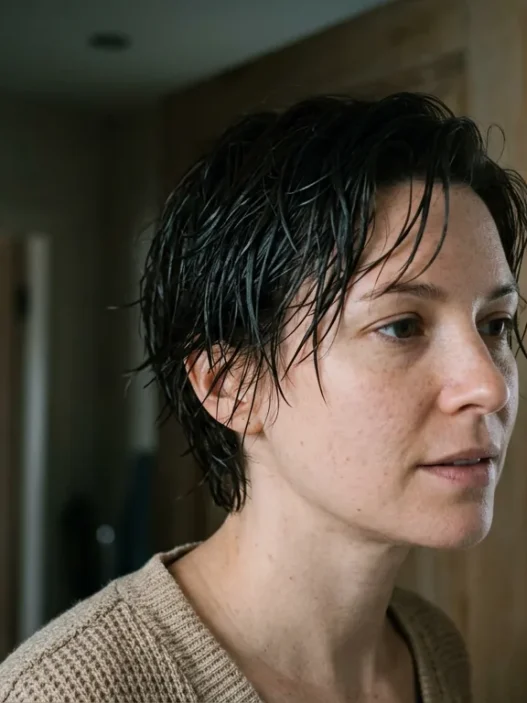
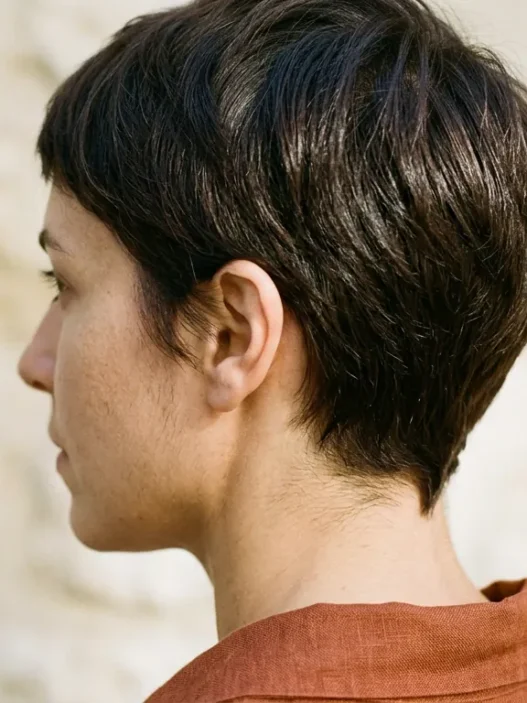
A soft pixie with length kept at the temples and crown, and tapered only at the nape, gives the wave room to show at the top while keeping the overall shape tidy. A textured crop at ear-length with a longer, wavy top section does the same thing at slightly more length. Both work. Neither requires a diffuser.
If you’re curious about taking this shorter, the guide on pixie cuts for fine hair is honest about which versions actually work and which ones need daily styling to look right. And if short but not quite pixie is your range, the short hairstyles for fine hair roundup has nine options worth bookmarking.

9. Two Patterns on One Head
The most common fine wavy hair situation, and the one nobody talks about enough: your hair does two different things at once. The front waves loosely. The back waves tightly. Or the crown goes straight while the underneath curls. Or one side bends left and the other side bends right. Welcome to having real human hair.
The wrong approach is to try to make both patterns match through styling — it’s a daily battle you’ll never win. The right approach is to cut for the dominant pattern and let the secondary pattern add texture rather than fight it.
In practice: if the back is tighter and the front is looser, cut to the front pattern’s ideal length and use the tighter back pattern to generate volume. If the crown is straighter, keep more length there so it falls gracefully over the wavier underlayers (see cut #6 above). The goal is a cut where both patterns end up looking like they’re part of the same design — which, honestly, they are.
A good stylist will section the hair when dry, look at what each section is doing, and cut with the actual pattern in mind rather than treating all of it as one uniform texture. That’s the real skill. When you find a stylist who does this, hold onto them. Talking to your stylist about hair texture is genuinely useful to read before your appointment so you can describe what you’re seeing at home.

Fine Wavy Hair Cut Questions, Answered
Should I get my fine wavy hair cut wet or dry?
Dry, if your stylist is willing to do it. Fine wavy hair behaves very differently when it’s wet versus when it’s air-dried — the wave shortens the length, the texture changes the way layers fall. A dry cut lets the stylist see exactly what they’re working with. If they cut wet, ask them to leave length and check again once it’s dry before finalizing.
How often does fine wavy hair need a trim?
Every eight to ten weeks for shorter cuts, ten to twelve for longer ones. Fine hair shows damage and split ends faster than thick hair because each strand has less protective cuticle mass. A trim also refreshes the shape — fine wavy haircuts rely on precise perimeters and specific layer placement, both of which drift over time.
Can fine wavy hair hold a layered cut without going flat?
Yes, but the layers have to be placed carefully. Layers that start too close to the roots remove all the weight at once and cause fine hair to collapse. The sweet spot for most fine wavy hair is layers beginning at or below the chin and running through the mid-shaft — never at the scalp. That placement lifts the mid-lengths without sacrificing the root volume that fine hair needs.
Does fine wavy hair look better longer or shorter?
It depends entirely on your wave pattern. A defined S wave can hold longer cuts beautifully because the wave creates visual volume. A loose bend pattern often looks better at medium lengths — collarbone to shoulder — where the bend has enough room to form without being dragged flat by excessive length. There’s no universal answer, which is why understanding your specific pattern matters before booking.
The through-line across all nine of these cuts is that the best haircuts for fine wavy hair work with whatever the hair is actually doing — not against it and not in spite of it. Find your wave pattern, find the cut that matches it, and then mostly just leave your hair alone. That’s genuinely most of the job.