









I spent about three years asking for the same thing at every salon appointment — a mid length haircut for fine hair that had some movement, some body, something. And every single time I walked out with layers. Lots of them. Bouncy, flicky, whispy layers that looked incredible for approximately four days and then went completely flat. It took an embarrassingly long conversation with a different stylist — one who actually stopped and looked at my hair before picking up the scissors — for me to understand what was going wrong. The layering wasn’t the solution. It was the problem.
What’s in This Post — Jump to the Part You Need
What the Industry Sells
Walk into almost any salon with fine, medium-length hair and ask for volume. Here’s what you’ll get pitched, reliably, year after year:
- Heavy layering throughout — face-framing, mid-shaft, sometimes even thinned at the ends
- A shaggy, razored texture with lots of disconnection between sections
- Curtain bangs as an add-on to “open up the face”
- Beachy waves styling advice (“just scrunch some sea salt spray in”)
- Feathered, wispy ends for “movement”
- A shoulder-length cut with graduation that’s technically a layer cake underneath
These things are sold as volume solutions. They look stunning in the chair, on freshly blow-dried hair, under good lighting. And honestly? Some of them look incredible for a weekend. The problem is that fine hair doesn’t hold structure the way thick hair does — and when you remove weight through aggressive layering, you’re not giving it lift. You’re taking away the only thing it had going for it.
The shag in particular is a recurring offender. I’ve seen it recommended constantly for fine hair because the texture “adds dimension.” But a shag cut relies on bulk to create that lovely messy body — the razored ends, the curtain bangs, the wispy bits all need something behind them to stand up. On genuinely fine strands, the look collapses within hours. You can read more about this pattern specifically in my post on the layering mistake I made for years on fine hair — it goes deeper into why the instinct to layer is so hard to shake.

What Actually Works
Here’s the list I wish someone had handed me years ago — the things that genuinely move the needle for fine hair at mid length:
- A blunt or softly blunt perimeter — weight at the ends is your friend, not the enemy
- Minimal internal layering, concentrated only in the top section if volume is genuinely flat there
- A collarbone-grazing length, which is long enough to have presence but short enough that gravity doesn’t win
- A slight concave shape at the back — this builds the illusion of thickness from behind
- Long layers only, if layers at all — short ones remove weight where you need it most
- A clean line around the face rather than wispy face-framing pieces that lose their shape
Notice what’s not on this list: razoring, thinning shears, heavy graduation. Those tools exist for a reason — they work brilliantly on thick or coarse hair. But on fine strands, they create the exact opposite of volume. They scatter the light instead of reflecting it, and scattered light reads as thin.
The science behind hair density is genuinely interesting here — fine hair has a smaller shaft diameter, which means each strand reflects less light individually. A blunt line puts many strand ends together in the same plane, bouncing light back in a unified way that reads as fullness. A heavily layered, wispy end does the opposite. This is not a feel-good theory. It’s geometry.

Where the Two Lists Meet
Here’s the thing, though. Both lists aren’t entirely wrong. The overlap is where the actually good haircuts live — and it’s more specific than either camp admits.
Some layering genuinely helps fine hair. Just not the layering the industry defaults to. A few long, soft layers dropped only into the bottom third of a mid-length cut — nothing higher than the chin — can create movement without catastrophically removing weight. The key word is a few. Not a full shag. Not five layers from ear to shoulder. Two, maybe three passes, all below the cheekbone. That’s the overlap: a blunt perimeter with a deliberate handful of long layers underneath.
And the curtain bang? Actually works, with caveats. A longer, heavier curtain bang — one that’s kept at cheekbone length or below — can add visual interest without sacrificing the weight of the rest of the cut. The problem is when it gets feathered too much at the ends, or cut too short, and suddenly you’ve got flyaways framing your face that you have to style every single morning.
The best mid length cuts for fine hair aren’t about adding texture or removing bulk. They’re about managing weight distribution so the hair falls where you want it — not where gravity decides.
What the overlap tells you is this: the goal is controlled movement, not maximum movement. Fine hair needs a perimeter that holds its shape for more than a wash or two. And that means being genuinely conservative with the scissors in places where stylists typically go enthusiastically to town.

The Weight Question Nobody Asks
Nobody ever walks into a salon and says “please preserve my weight distribution.” We ask for volume, movement, texture — all code for the same thing, which is hair that doesn’t look flat. But here’s the reframe that changed how I talk to every stylist now: instead of asking for volume, I ask where the weight currently sits and where we want it to sit after the cut.
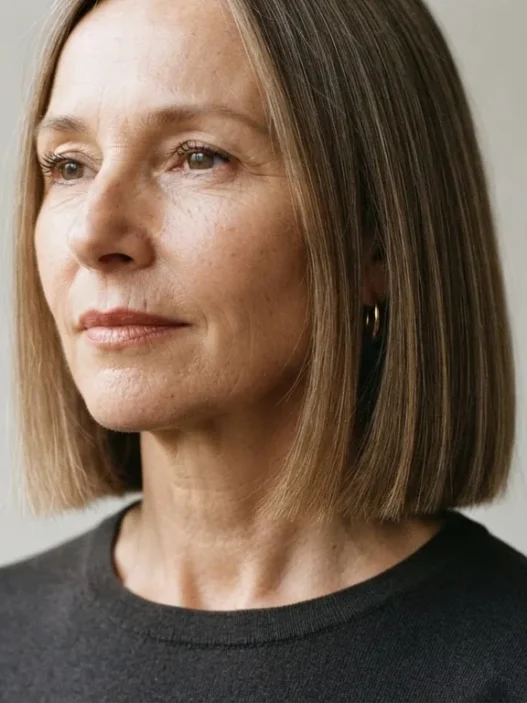
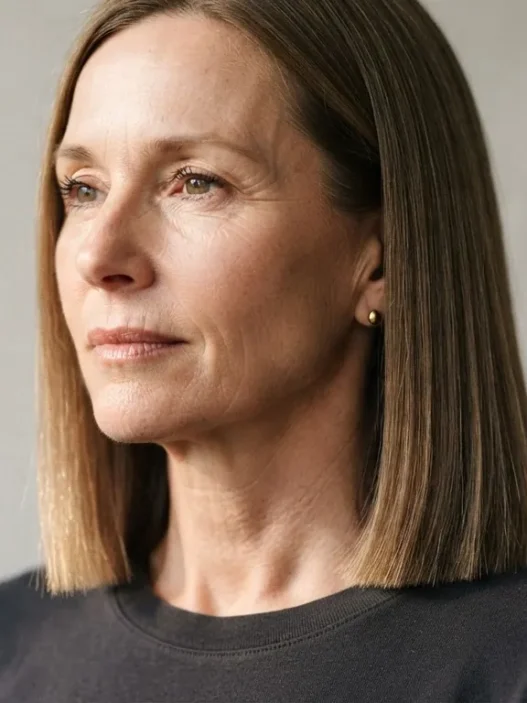
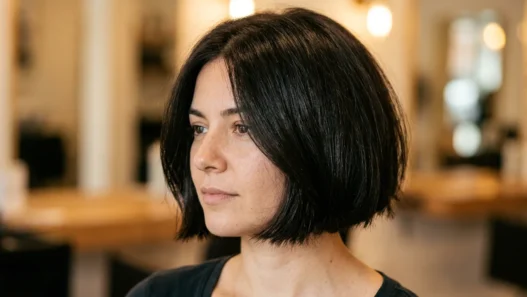
For fine hair at mid length, weight should pool at the perimeter — that slightly blunt or one-length line at the bottom. When layers pull weight upward or scatter it into disconnected sections, the bottom of the hair looks thin and transparent. See the woman in the photo here — look at how her ends sit together with actual presence. That’s a blunt perimeter doing its job. Compare that to a heavily layered look where the ends taper into near-nothing and you can practically see through the tips.
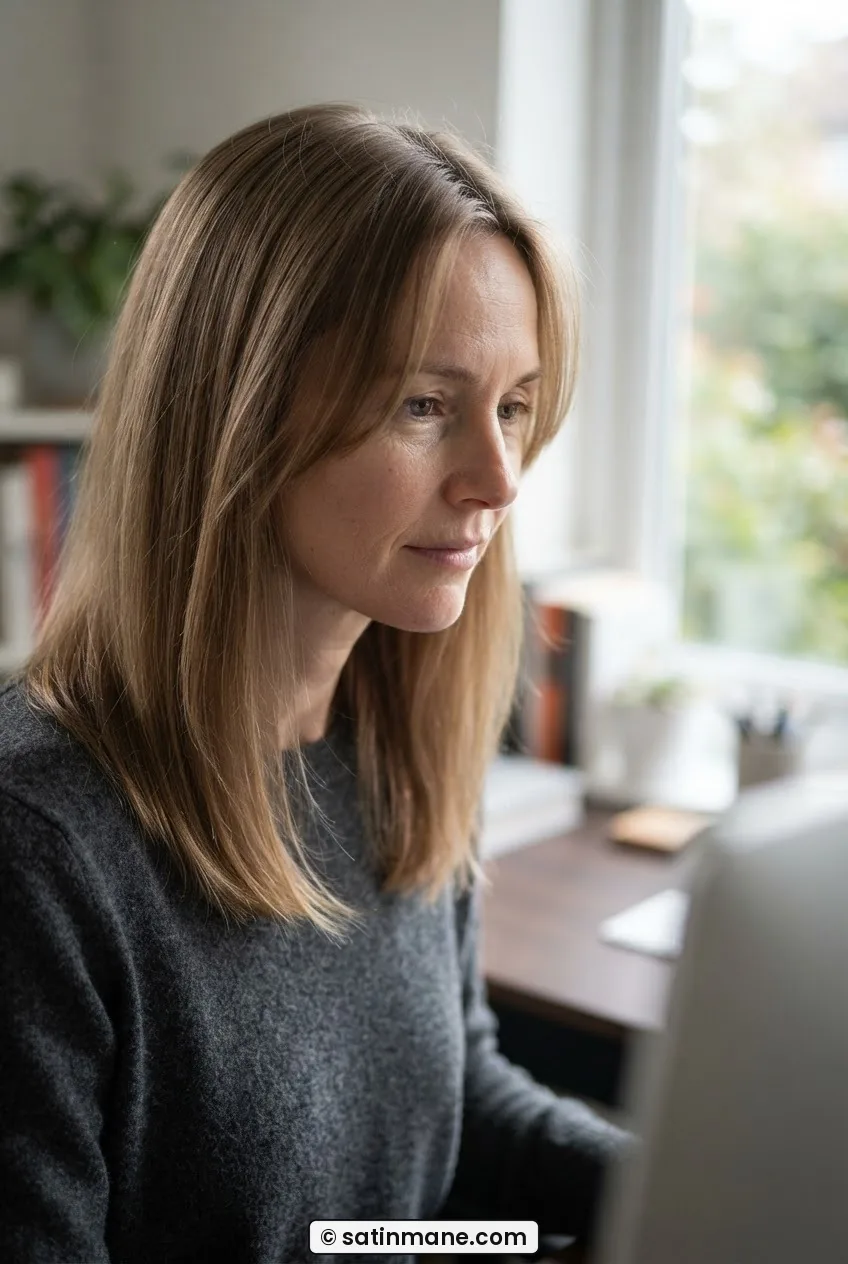
This is also why very fine hair benefits more from a slightly shorter mid length — think collarbone rather than mid-back — than from going longer. Longer lengths give gravity more time to work. By the time fine hair hits the middle of your back, it’s a flat curtain. Collarbone length still has enough weight-to-length ratio to hold a shape. You can look through the options for shoulder-length fine hair if you’re still deciding where exactly to land on the length spectrum.
I’ll be controversial here: I think the advice to go shorter when fine hair is thinning — the kind of thinning you might start noticing in your late thirties or forties — is often wrong. A short hairstyle for fine hair can look incredible, and I’ve seen women transform their whole look by going cropped. But if you’re going short primarily because you’re told the length is dragging your fine hair down, that’s worth questioning. Sometimes a strategic weight-line at the collarbone does more than a pixie. It really depends on your specific density, not a blanket rule.
Face Shape and the Mid-Length Sweet Spot
Mid length is arguably the most forgiving length for most face shapes — which is partly why it’s so popular and partly why it gets so badly butchered. The general principle is that the weight line of the hair should land at a point that either elongates or softens your face depending on what you’re working with.
For round faces: length is your friend. A mid-length cut that grazes the collarbone creates a vertical line that lengthens the overall silhouette. Avoid cuts that end exactly at the jaw — that’s the widest point, and finishing there makes the face look rounder. For oval faces: lucky you, basically anything works, but a clean collarbone-length one-length cut with minimal layers is particularly flattering because it shows off the symmetry without distracting from it.
For square faces: soft movement around the jaw matters more than length per se. A few long face-framing pieces — not wispy, actual weight-bearing pieces — can soften the angle without removing too much from the perimeter. For heart-shaped faces: the mid-length territory between chin and collarbone is genuinely the sweet spot. It balances the wider forehead with some visual weight lower on the face.

What’s worth noting across all of these: the shape principles work best when the hair still has weight at the perimeter. A heavily layered mid-length cut loses its ability to “land” at the right visual point, because the ends aren’t defined enough to create that line. This is why a bob for fine hair so often outperforms a “layered lob” — the bob has a defined perimeter that actually does the face-shaping work. The lob with lots of layers just… drifts.
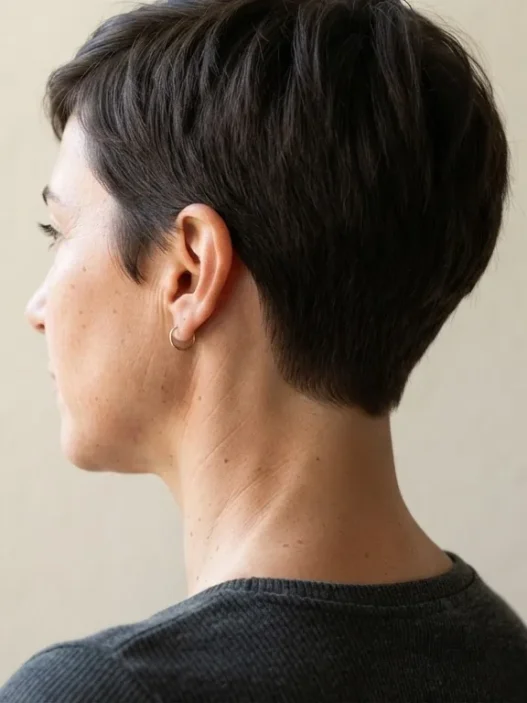
If you’re thinking about going even shorter to create more definition, it’s worth a look at pixie cuts for fine hair — specifically the honest version, because the styling realities are quite different from what the Instagram photos suggest. And if low maintenance is genuinely the main goal (not just the stated goal — the real goal), then what low maintenance actually means is worth understanding before you commit to anything.
The honest summary: face shape guides the landing point; hair type determines what the perimeter can do when it gets there. Fine hair at mid length does its best work when those two things are thought about together, not separately. More on the broader low-maintenance angle in my post on what low maintenance actually means for a haircut — because the definition varies wildly depending on your hair type.
Quick Answers About Fine Hair Cuts
Should I ask my stylist not to use thinning shears?
Yes, and I say this without hesitation — tell them upfront. Thinning shears are designed to remove bulk, which is exactly what fine hair doesn’t have. Some stylists use them habitually on the ends for “texture,” not realising the hair doesn’t need it. You’re not being difficult; you’re giving them useful information about your specific hair.
Can I still get a shag cut if I have fine hair?
A shag is a high-maintenance cut for fine hair — not impossible, but it requires daily styling to look intentional rather than flat. If you love the aesthetic, ask for a “soft shag” with minimal internal layering and a heavier perimeter than a traditional shag. The more authentic the shag (razored, heavily layered), the more work it is to maintain on fine strands.
How often do I need to trim a mid-length cut on fine hair?
Every 8–10 weeks for a blunt or near-blunt cut — the perimeter line loses its sharpness as ends split and break, and a defined perimeter is doing a lot of the visual work for you. If you go longer between trims, the ends start to look transparent rather than full, which undoes everything the cut was meant to achieve.
Does hair colour make fine hair look thicker?
It genuinely can. Dimensional colour — highlights, babylights, tonal variation — creates the appearance of depth that single-process colour doesn’t. A flat, single-shade colour on fine hair can actually make it look thinner by removing shadow. You don’t need to go dramatically multi-toned; even a subtle balayage that’s two shades from your base adds enough variation to read as fuller. Worth asking your colourist about alongside the cut conversation, because the colour techniques for fine hair decisions compound each other.
If there’s one thing I’d say going into your next appointment: bring the vocabulary. Ask about weight distribution. Ask whether they’d use thinning shears. Ask where the layers will start. Not because you need to be in charge of the scissors — that’s what the stylist is for — but because a stylist who can answer those questions clearly is probably thinking about your hair more carefully than one who just reaches for the same tools they always use. That conversation, more than any specific technique, is what changed my haircuts. Good luck at your next one.