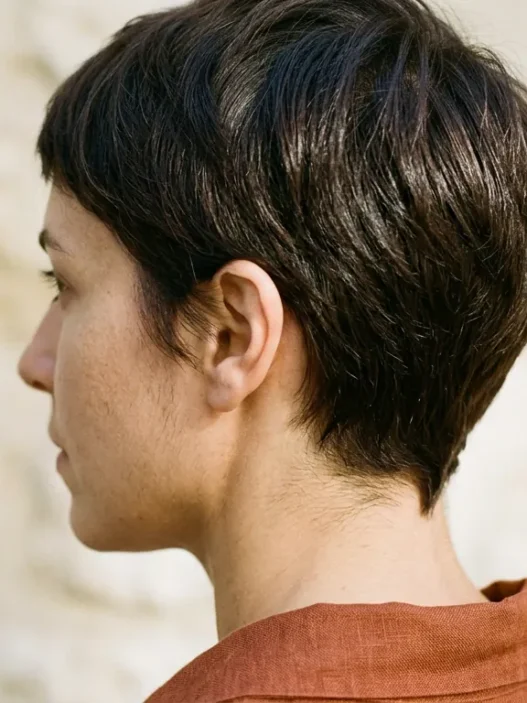













Every stylist I’ve ever sat with has eventually said some version of “the right cut can lift your whole face.” And I used to nod politely and think — yeah, sure. Then I actually started paying attention to which shapes were doing what, especially when it comes to haircuts for a double chin. Because there is a real difference between a cut that draws the eye down and one that pulls it up and along the jaw in the most flattering way.
What I noticed is that the “right cut” conversation almost always ignores your actual life. So that’s what this is really about. The constraint comes first — the cut follows from it.
What We’re Covering — Jump Ahead
- 1. For Someone Who Swims
- 2. For Someone on Nights
- 3. For Someone Who Runs in the Morning
- 4. For Someone in a Helmet
- 5. For Someone Not Sleeping
- 6. For Someone Who Hates Mirrors at 7am
- 7. For Someone in a Humid Climate
- 8. For Someone Who Wears a Ponytail Every Day
- 9. For Someone Always on Video Calls
- 10. For Someone Growing It Out
- 11. For Someone Who Just Wants One Cut a Year
1. For Someone Who Swims
Pool water is the enemy of any cut that depends on a precise blow-dry. So if you’re in the water three, four, five times a week, you need a shape that resets fast. For someone with a rounder jaw or a double chin, the instinct is often to keep hair longer — to “cover” things. But length plus chlorine damage is its own nightmare, and long wet hair plastered to the sides of your face does exactly nothing flattering.
The cut I keep coming back to for swimmers is a textured pixie with a longer top — enough length on top to add height (which visually lengthens the face), with sides kept short so there’s nothing weighing down around the jaw. The widest point of the cut sits at the crown, not the cheek. That’s the whole trick. You can read more about how short cuts work on rounder faces in the short haircuts for round faces honest version — it challenges a lot of the standard advice, in the best way.
Upkeep: every 5–6 weeks minimum. This shape only works when it’s trimmed. Let it go and the sides lose their structure and start to puff out at exactly the wrong spots.

2. For Someone on Nights
Night shifts destroy hair routines. You sleep weird hours, you tie it up to sleep, you wash it when you can rather than when you planned to. A style that needs morning styling is completely pointless when you’re coming home at 7am.
For someone in this situation who also wants a double chin to read less prominently on their face, the answer is a chin-length bob with a slight angle — longer at the front, shorter at the back. The front pieces angle toward the jaw and chin, which draws a diagonal line rather than a horizontal one. Horizontal lines at chin level emphasize width; diagonal ones break it up. The back stays short enough to dry quickly. No diffuser required, no round brush required.
There’s a whole post on this specific cut — the bob cut for round face shapes that actually lengthen rather than widen — that goes into the angle detail much more carefully than I can here. Worth bookmarking before your next appointment.
Upkeep: every 7–8 weeks is realistic. The angle keeps reading even as it grows.

Seeing the Angled Bob Cut Live
3. For Someone Who Runs in the Morning
You come back sweaty. You shower. You have 12 minutes before you need to leave. This is a completely different constraint from the swimmer — it’s about speed and frizz recovery, not chlorine damage.
A layered lob sitting just below the collarbone works beautifully here, particularly if your hair has any natural wave to it. The layers mean it air-dries with movement and texture rather than going flat and limp against the sides of your face. The length is key: a lob that grazes the collarbone keeps your neck visible, which is one of the most straightforward ways to soften the visual heaviness of a double chin. Long hair bunched around the shoulders closes off the neck and reads heavy.
She’s got a shape similar to what I’m describing — look at how the front pieces frame the collarbone in the photo rather than landing on the shoulder. That’s the specific length to ask for.
Upkeep: trimmable every 10–12 weeks. The layers need refreshing but it’s forgiving.

4. For Someone in a Helmet
Cyclists, horse riders, construction workers, equestrians — helmet hair is a real category of constraint. Any cut that depends on volume at the crown is destroyed before 9am. Any cut with a fringe gets plastered flat. You need a shape that either doesn’t care about being crushed or bounces back from it with minimal effort.
For flattering a double chin in this context, I’d go with a tapered nape cut with a slightly fuller top. It sounds counterintuitive for helmet use, but the tapered nape actually helps the helmet sit properly, the back stays neat, and the fullness is at the crown so when the helmet comes off you’re not fighting it at the cheekbone level. You shake it, run your fingers through, and it reads put-together.
The key instruction to give your stylist: fullness above the ears, not at the ears. Volume at ear level widens the face. Volume at crown level elongates it.
Upkeep: 6 weeks. The taper gets shaggy fast.

My personal pick here is the tapered nape cut — I’ve seen it on three different women with very different face shapes and it works every single time. The key is keeping the taper clean at the back. The moment it gets fluffy at the nape, it softens the whole line and loses its sharpness. This is the one I’d choose if my routine was chaotic and I only had control over one variable: the trim schedule.
5. For Someone Not Sleeping
New parents. Caregivers. Anyone running on four hours. When you’re this tired, your relationship with your reflection is complicated, and you don’t need a cut that requires any decision-making in the morning.
The shape I’d recommend here is a soft shag with face-framing curtain layers. It sounds high-maintenance because the word “shag” has a styling reputation — but a well-cut shag on the right texture air-dries into shape. The curtain layers do specific work around a double chin: they create a V-line at the center of the face, drawing the eye inward and downward toward the nose rather than outward toward the jaw. That’s very different from layers that fan out horizontally.
Look at how her layers fall in the photo. They’re not all one length — the face-framing pieces are longer and fall forward, which creates that V-shape I’m talking about. That framing is doing a lot of quiet work.
Upkeep: depends entirely on your hair texture. Fine hair needs a trim every 8 weeks to stop the shag collapsing. Thicker hair can push to 10–12.

6. For Someone Who Hates Mirrors at 7am
Some people’s entire morning routine philosophy is: do it without looking. Style by feel, leave the house, carry on. And honestly? Valid.
For this person, the cut has to work without any visual checking. That means a shape with a strong internal structure — something that falls into place without guidance. A blunt bob at jaw-length with a center part does this. The weight line is so deliberate that it basically snaps back to its shape after sleeping. Run a hand through it, leave. The center part is important here because off-center parts draw the eye to one side, which creates an asymmetry that can read as imbalance. Center parts create vertical symmetry, which elongates.
The one caveat: jaw-length blunt bobs sit right at the chin, so the weight of the hair is level with the widest part of the lower face. That’s exactly where you don’t want weight if you’re trying to minimize a double chin. The fix is to ask your stylist to cut the back very slightly shorter, so the overall silhouette tapers — rather than a straight-across line that emphasizes the jaw’s horizontal shape.
Upkeep: 6–7 weeks. Blunt bobs show growth very clearly.

7. For Someone in a Humid Climate
Humidity expands hair. Fine, straight hair goes limp and flat. Wavy hair goes frizzy and wide. Both of these outcomes work against a double chin — limp hair has no lift and reads heavy on the lower face, while width at the sides emphasizes horizontal breadth.
The cut that survives humidity best for this face concern is a short layered pixie with razored edges. Razor cutting removes bulk from the ends so that even when the hair expands in heat, it doesn’t thicken into a mushroom shape around the ears. The layers mean any natural movement — wave, curl, texture — becomes part of the look rather than working against it. And short is honest in this context: you’re not managing volume when there isn’t much hair there to expand.
Understanding your face shape is useful before committing to anything this short, because a pixie is confident and direct — it works beautifully on round faces when the proportions are dialled in, but it’s not a subtle cut. You can see on her in the photo exactly how the short sides keep the attention moving upward rather than widening outward at the cheekbone.
Upkeep: 5–6 weeks, and yes, that is frequent. This is not a low-frequency cut. The tradeoff is that your daily routine is basically nothing.

8. For Someone Who Wears a Ponytail Every Day
If your default is to pull your hair back, you may feel like the front sections never really matter — but they’re actually doing the most important work. The sections around your face when everything else is tied back are what determine whether the ponytail reads “quick and clean” or “I gave up.”
A medium-length cut with long face-framing layers left loose at the front is built for ponytail people who care about the framing. The back and sides are long enough to tie back cleanly. The front sections — cut specifically to frame the face when loose — can stay out or be loosely tucked behind one ear. These forward-falling pieces create that diagonal line at the jawline that visually counteracts the roundness below the chin.
This is also one of the cuts where how face shape interacts with layer placement matters a lot — because layers placed too high frame the cheeks rather than the jaw, and for a double chin concern you want the opposite. Low, long layers only.
Upkeep: 10–12 weeks. Forgiving growth pattern. One of the more sustainable options on this list if salon time is limited.

9. For Someone Always on Video Calls
Video calls have their own specific optics. You’re seen from the front, usually slightly from below (laptop camera angle), and you’re mostly static. That below-angle actually emphasizes the chin and jaw area more than real life does, which means a double chin reads more prominently on screen than in the mirror.
The cut I’d choose specifically for video is a collarbone-length lob with side-swept layers. The side sweep creates visual diagonal movement that the flat-on camera actually picks up well. The collarbone length keeps the neck visible — crucial for that camera angle — and the layers prevent the heavy “curtain” look that straight blunt lengths create on screen.
Also worth noting: wearing your hair tucked behind one ear on calls (asymmetric) reads more dynamic than hair falling symmetrically on both sides. Something to play with even without changing the cut. If you want to go deeper on which shapes genuinely work for round face shapes, there’s a whole section on the site worth exploring — it’s one of the most misunderstood face categories in haircut advice.
Upkeep: 8–10 weeks. Low drama as it grows.

10. For Someone Growing It Out
Growing out a short cut is one of those phases where people stop getting trims entirely — because they think they’ll lose length. That’s the mistake. Strategic trims during a grow-out are what stop it looking ragged. And when you’re growing out through the chin-and-jaw zone, the in-between lengths can be particularly unflattering for a double chin if not managed well.
The shape to aim for at the awkward 3–6 month stage is a blunt-ish collarbone length with the ends kept intentionally straight. The weight line below the chin — rather than at it — means the widest point of the silhouette is below the problem area rather than sitting right on top of it. Ask your stylist to clean the ends at each trim rather than adding layers — layers at this stage create wispy unevenness that reads messy rather than textured.
If you’re coming from a pixie specifically, the honest version of the low-maintenance haircut has a really useful section on managing the grow-out phases without losing your mind — or your shape.
Upkeep: this is the hardest one to answer. You’re trimming but not cutting, which feels counterintuitive. Budget for a small trim every 8 weeks minimum.

11. For Someone Who Just Wants One Cut a Year
One cut a year is a real preference and I’m not going to pretend it’s irresponsible. Some people genuinely hate the salon experience. Some don’t have easy access. Some just don’t have the bandwidth. The question becomes: which shape holds its intent the longest?
For someone with a double chin who wants maximum time between cuts, the answer is a long one-length cut sitting below the shoulder with a slight internal layer. One length grows predictably — there are no layers to lose their shape, no blunt weight lines to grow out of position. The internal layer (just one pass, not a full layered cut) gives enough movement that it doesn’t look like you just haven’t cut it. For double chin concerns at this length, the styling variable matters: keeping the hair in front of the shoulders rather than behind them keeps the neck slightly framed and visible. Hair behind the shoulders widens the silhouette at the jaw level.
The downside is that at one year without a trim, split ends will be visible and the ends may look wispy. Maintaining long hair between cuts matters more at this frequency than it does for anyone else on this list.
Upkeep: one cut a year as intended. The internal layer may benefit from a refresh at the 8-month mark if you can manage it — but it’s not a disaster if you can’t.

Questions I Get About This
Does hair length actually make a visible difference to a double chin?
Yes — but it’s less about length and more about where the widest point of the silhouette sits. Hair that’s widest at cheek or jaw level draws attention to that area. Hair that’s widest above the cheekbone or below the chin shifts the eye. It’s optical rather than magical, but it’s real.
Should I avoid short haircuts if I have a double chin?
Not at all — this is one of the most persistent myths in face-shape haircut advice. Short cuts can work very well, as long as the shape adds height at the crown rather than width at the ears. A pixie with a taller top is often more flattering than mid-length hair that hangs flat against the sides of the face. The short haircuts for round faces honest version makes this case more thoroughly than most styling guides do.
What about bobs — are they risky with a double chin?
A blunt bob sitting exactly at the jaw is the most common mistake — the horizontal weight line lands right on the double chin. But an angled or graduated bob, where the front is longer than the back, creates diagonal lines that are genuinely flattering. The difference between a bob that works and one that doesn’t is often just an inch of angle. There are nine good examples in the bob cut for round face shapes that lengthen rather than widen post.
Is there one face-shape rule I should always follow?
The most reliable one: keep your neck visible. Whatever length you choose, avoid letting the hair fall heavily around the sides of the neck and jaw — that’s the one consistent habit that flatters almost every face type. Beyond that, rules are starting points, not sentences. Your stylist should be adjusting based on your specific proportions, not a generic guide.
The constraint they all share? Every cut above was chosen because it stops fighting the daily reality of whoever is wearing it. A beautiful cut you can’t maintain is just a bad cut on a delay. Pick the one that fits your actual Tuesday, not your ideal one.