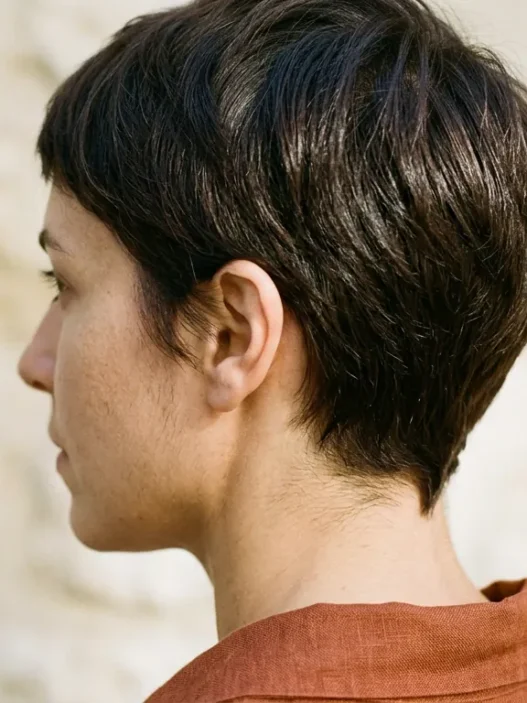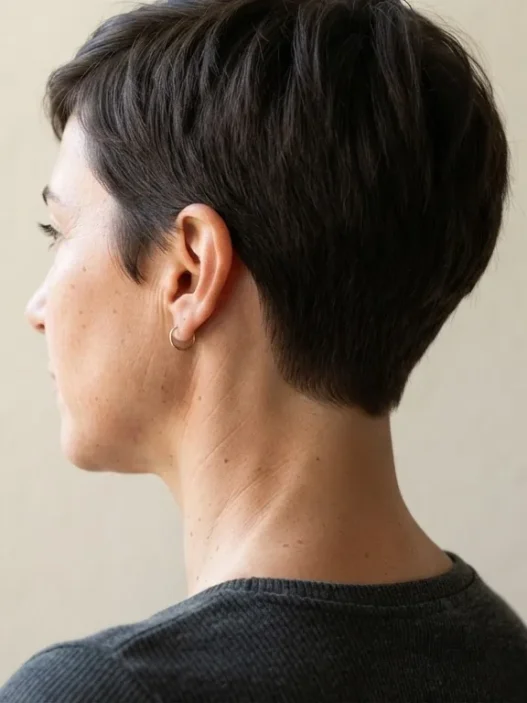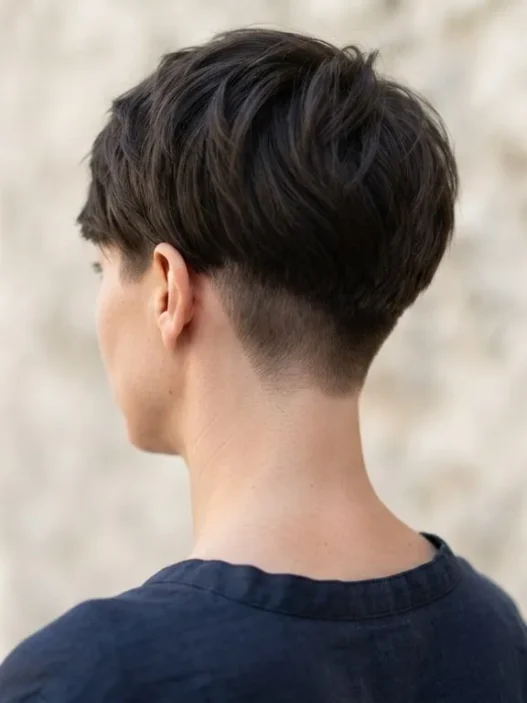













I booked my first pixie on a Tuesday with zero research. I just pointed at a photo and said “shorter” until it was done. Three weeks later I understood nothing about why it looked the way it did, why it was behaving the way it was, or what I should have asked for instead. That experience is why I now care deeply about knowing the construction of a cut before committing — not just what it looks like fresh from the chair, but where the weight lives, where the graduation falls, and what it costs you on a Wednesday morning when you’re already running late. These eleven short pixie haircuts are laid out exactly that way.
What’s Inside: 11 Pixie Cuts, Ranked by Real Effort
- The One That Air-Dries Flat
- The One With the Tapered Nape
- The One That Adds Volume to Fine Hair
- The One With a Disconnected Undercut
- The One You Trim Twice a Year
- The One That Works on Round Faces
- The One With a Textured Crown
- The One With a Hard Side Part
- The One Built for Thick Hair
- The One With Forward-Swept Fringe
- The One That Grows Out Gracefully
1. The One That Air-Dries Flat
Weight distributed evenly across the occipital bone, clipped close at the sides with no graduation — so everything dries parallel to the skull. The top is left a little longer (maybe an inch and a half) with blunt interior cutting rather than point-cutting, which means the hair lies flat instead of flicking up. No internal layers fighting each other. No cowlick drama because the weight keeps things anchored.
This suits straight to slightly wavy hair and oval or long face shapes where adding height isn’t a priority. Morning routine: towel dry, run one pass of a wide-tooth comb, done. If your hair is fine and you want this to lie flat without product, it genuinely can. If it’s coarser, budget one pump of smoothing cream.
At the chair, say: “No graduation on the sides, keep the top blunt-cut and flat-lying, close at the nape with no taper.”
2. The One With the Tapered Nape
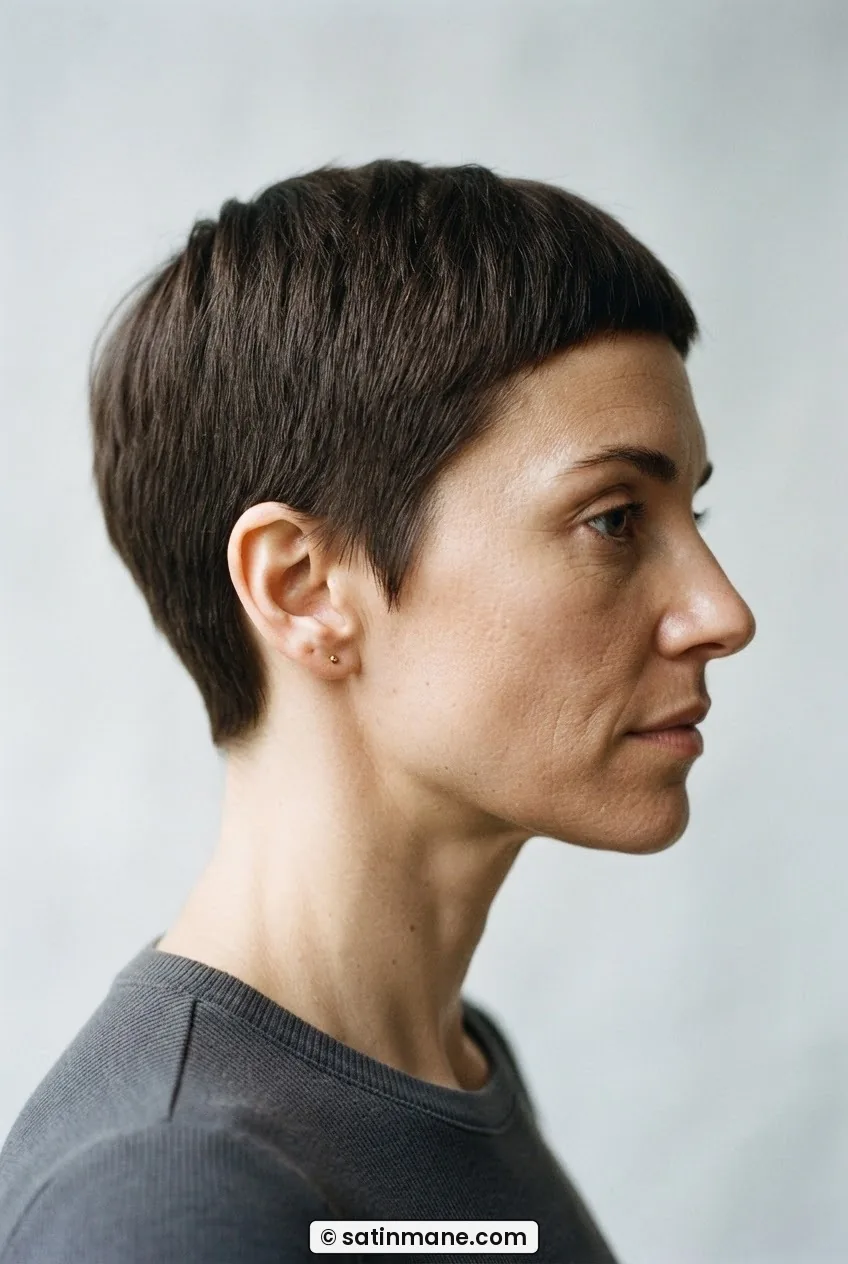
This is the cut I keep coming back to when I talk about pixies with real structure. The taper runs from about two inches above the nape down to the hairline — clippers on skin at the very bottom, blended upward through increasingly longer lengths, so the graduation is visible but the line is clean. Sides are scissor-cut close, the crown sits round rather than peaked. The fringe, if there is one, sweeps slightly rather than falling straight across.
Look at her in the photo — you can see exactly where the taper fades through her nape. That’s the detail that makes this cut feel polished even three weeks post-trim, when everything else starts looking shaggy.
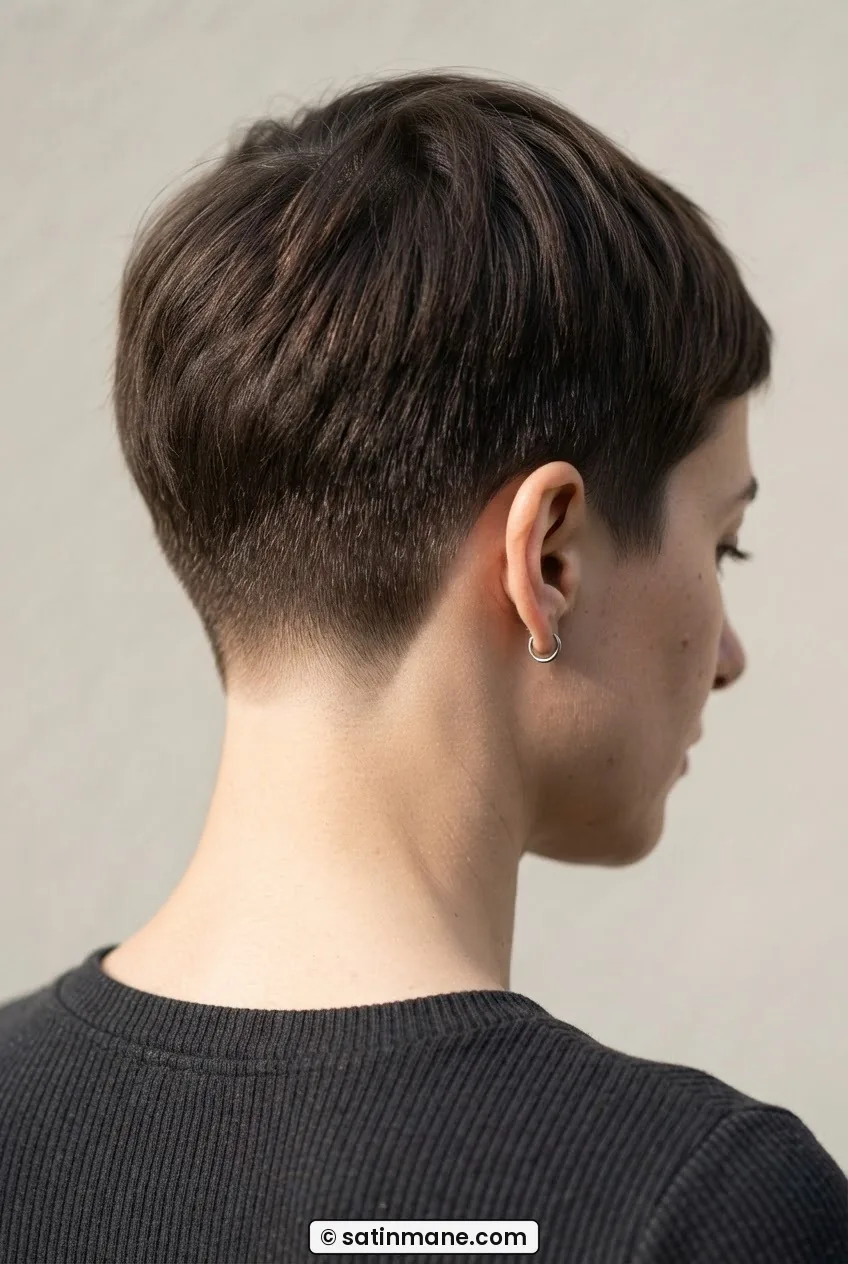
It works across most face shapes and behaves well on medium-density, straight or wavy hair. The catch: the nape needs tidying around week four. Not a full cut — just a five-minute clipper pass if you’re brave, or a quick salon visit. Without it, the taper starts reading as “neglected” rather than “intentional.” That’s the honest version of this shape.
At the chair, say: “Tapered nape, skin fade at the hairline blending to scissor-cut at the crown, round shape on top, no hard line at the sides.”
Watching a Taper Get Cut in Real Time
3. The One That Adds Volume to Fine Hair
Here the weight is removed from the perimeter and redistributed through internal point-cutting, creating a disconnected puffiness at the crown that reads as body rather than bulk. Sides are cut close — closer than you’d think — so the crown hair has something to contrast against. The nape is razor-finished, not clipped, which softens the edge without removing weight from the wrong places.
Fine-haired women are often told their hair “can’t do” a pixie. That’s not true. I’d push you to read about pixie cuts for fine hair before you take anyone’s word for it, because the right construction makes a real difference. This particular shape is built specifically for low-density hair — the internal point-cutting removes weight without collapsing the silhouette.
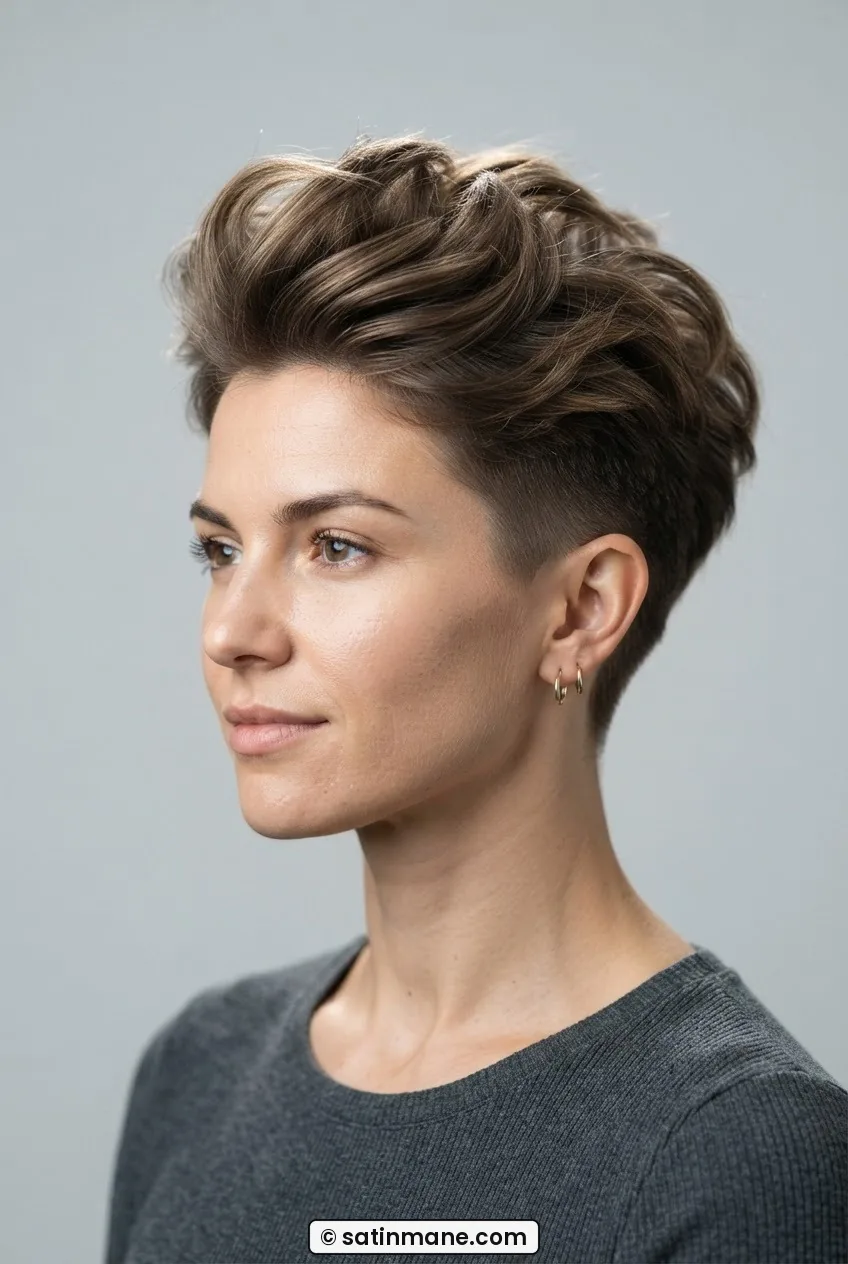
Morning cost: a small amount of volumizing mousse worked through damp hair and a quick diffuse or air-dry. Finger-lifting the roots once while it dries is all the “styling” this needs. Not zero effort, but close.
At the chair, say: “Internal point-cutting through the crown for volume, close at the sides, razor-finished nape — I want the weight gone from the perimeter, not the top.”
4. The One With a Disconnected Undercut
This is the most architectural shape on this list, and I want to be clear with you: it is also the most work to maintain. The undercut is clipped to the skull — often a grade 1 or 2 — and there is a deliberate, unblended ledge where it meets the longer top section. The top can be two or three inches, sometimes more, swept or styled away from that disconnection so the contrast reads clearly.
It looks extraordinary. It also needs the undercut refreshed every three to four weeks or the disconnection collapses and you just have… uneven hair. The styling on top requires product and usually a brush. If you love this shape, go in clear-eyed about the upkeep rather than being surprised by it later.

Suits oval, heart, and oblong faces well. Square faces can pull it off if the top is styled with enough height. Round faces — it depends on where the disconnection sits; a stylist consultation is worth it here before committing. You can also dig into more detail on short haircuts for round faces to figure out whether the geometry works for you first.
At the chair, say: “Hard disconnection between the undercut and the top section — no blending, clipper grade 1 or 2 underneath, leave the top long enough to style away from the parting.”
5. The One You Trim Twice a Year
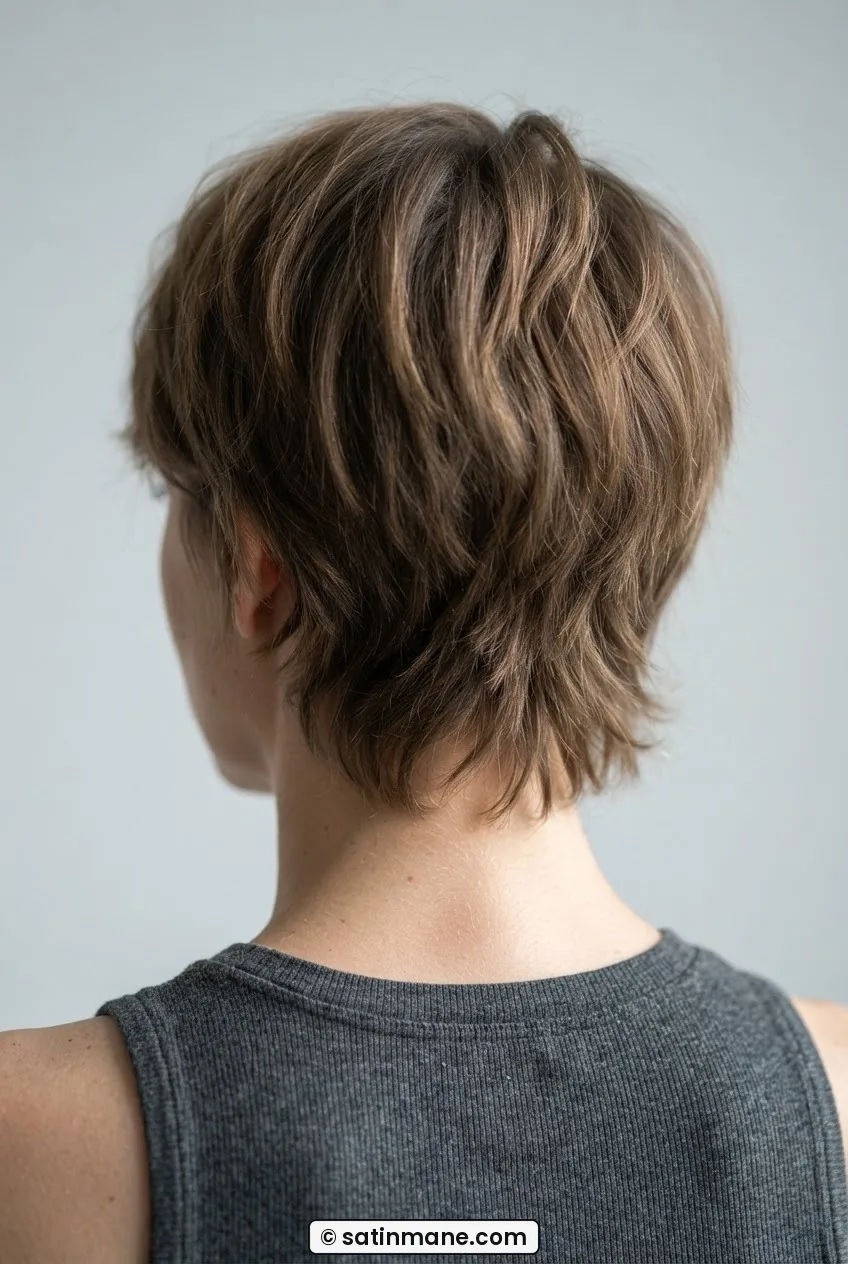
Technically this is a very short pixie that’s been allowed to grow into a longer pixie — hair at the temples falling to the cheekbone, nape grown past the collar, crown slightly shaggy. It works because the cut underneath was good. The original graduation and weight distribution hold their shape as the hair grows, so instead of going awkward, it just gets… softer. More of a grown-out shape than a neglected one.
This is my personal pick. I’ve had this cut for two stretches of about eight months each, and both times I was genuinely shocked by how long I could go between trims. The key is asking for the right shape at the start — if the initial cut is built to grow well, you’re not fighting it for the next six months.
It suits wavy and slightly textured hair better than pin-straight hair, which can look unintentional at the longer lengths. The morning cost when fresh: nearly nothing. By month three: maybe a swipe of pomade through the crown to control the flick. By month six: you’re basically in a longer pixie and everything has its own shape. There’s a whole guide to hairstyles for growing out a pixie if you want to see where this shape leads when you decide to keep going.
At the chair, say: “I want this cut to grow well — prioritize the graduation at the back and the perimeter softness over keeping it short. I’m planning to trim it twice a year, maximum.”
6. The One That Works on Round Faces
Weight removed from the sides, height added at the crown through layering rather than just length. The key cutting decision here is keeping the sides flat — clipper-cut or scissor-cut close to the temple — while building the crown section up with internal layers that lift. The silhouette, seen from the front, is taller than it is wide. That counteracts the roundness rather than echoing it.
The nape is typically tapered to keep the back narrow and not add visual width there either. A side-swept fringe works better than a blunt straight-across fringe for this face shape — it gives the eye a diagonal to travel rather than a horizontal line at the forehead.

Morning ask: finger-dry the crown upward while it’s damp, apply a pea-sized amount of paste for hold. Two minutes. The silhouette does the work.
At the chair, say: “Close on the sides and tapered at the nape, internal layers through the crown for height, side-swept fringe — I want the overall shape taller than wide.”
7. The One With a Textured Crown
Razor-cut or heavily point-cut through the crown, leaving the ends deliberately choppy and separated rather than smooth. The sides are still clipper-cut or close-scissored for contrast. What you get is a crown that has visible movement and piece-y separation even without product — the texture is built in at the cutting stage, not added afterward with paste.
This is a great shape for women whose hair has natural texture, wave, or slight frizz, because the irregular cutting works with the hair’s own movement rather than fighting it. Styling a textured pixie can range from a quick scrunch to a more deliberate piece-by-piece approach with matte paste — it depends how defined you want the result.
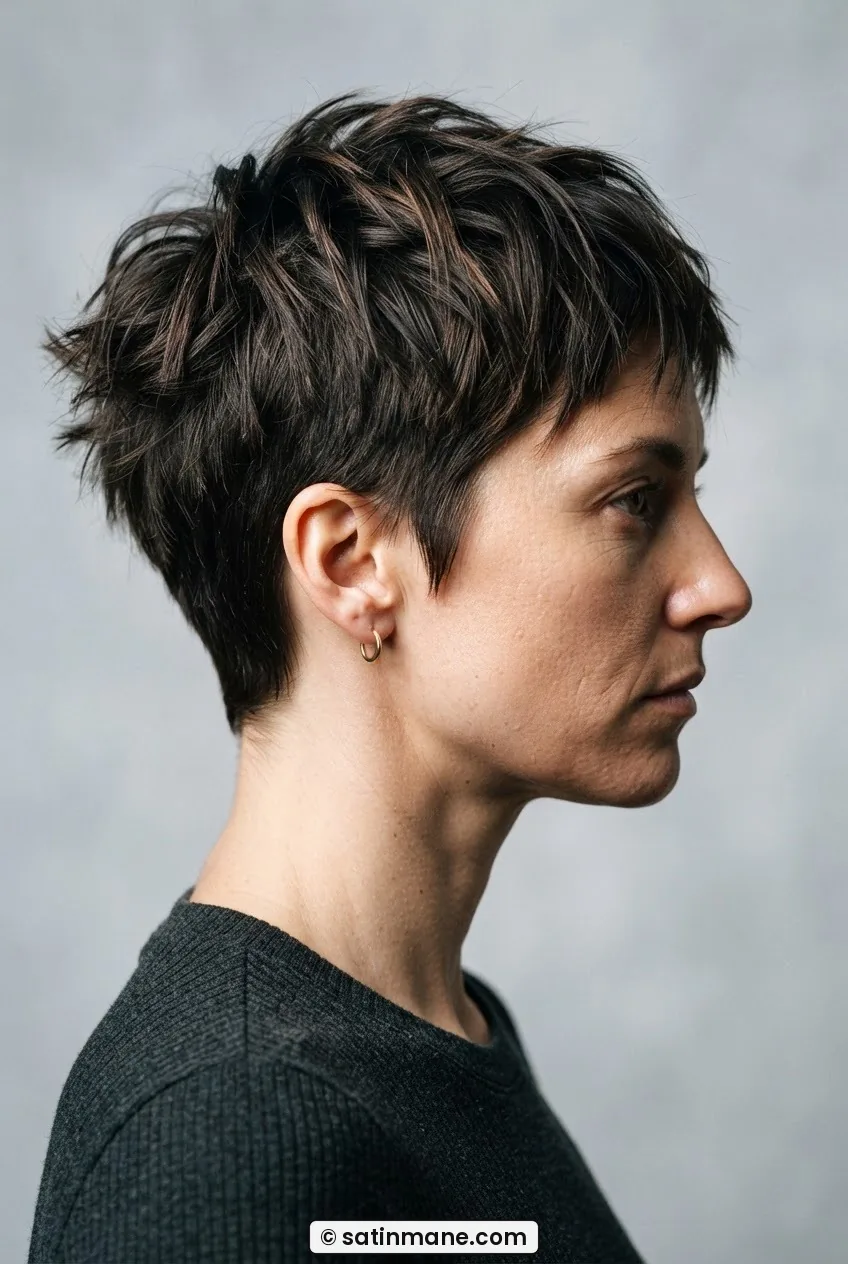
At the chair, say: “Razor or heavy point-cut through the crown for texture and piece separation, clipper-clean on the sides, I want the texture to show without needing product every single day.”
8. The One With a Hard Side Part
A deliberate, defined parting — usually created at the cut, sometimes shaved in — with the hair on the longer side swept across and the shorter side cut very close. The asymmetry is the whole point. One side of the head reads as substantial and styled; the other is almost bare. The contrast is sharp, the look is precise, and it photographs extremely well.
The honest cost of this: you need to style the longer side every morning or it reads as “forgot to brush” rather than “intentional.” A bit of product and one pass of a brush or comb is usually all it takes, but that is not the same as nothing. And the shaved part — if you go that route — needs refreshing on the same schedule as the nape on any undercut shape. Every three to four weeks, realistically.

Suits angular and oval faces particularly well. Heart-shaped faces, too, if the swept side falls toward the wider forehead. You can read more broadly about hairstyles for short hair if you want to see how this kind of asymmetric decision plays out across different structures.
At the chair, say: “Hard side part, close on the short side, the longer side should have enough length to sweep across and stay — either cut the parting in or shave it, I’m open to both.”
9. The One Built for Thick Hair
Thick hair in a pixie needs weight removed from the interior of every section, not just the perimeter. The cutting technique here is slide-cutting or slicing — running the scissors along the length of the hair shaft to remove density without removing length. The result is a crown that lies down and moves rather than poofing outward. Without this, thick hair in a short cut rounds out like a mushroom and no amount of product fixes it.
The sides should be clipper-graduated and the nape tapered fairly short to keep the overall silhouette in proportion to the volume the hair naturally wants to create. A razor finish at the perimeter also helps. This is one of those shapes where the skill of the cut matters more than the design — find someone who’s comfortable with slide-cutting on dense hair before you commit.
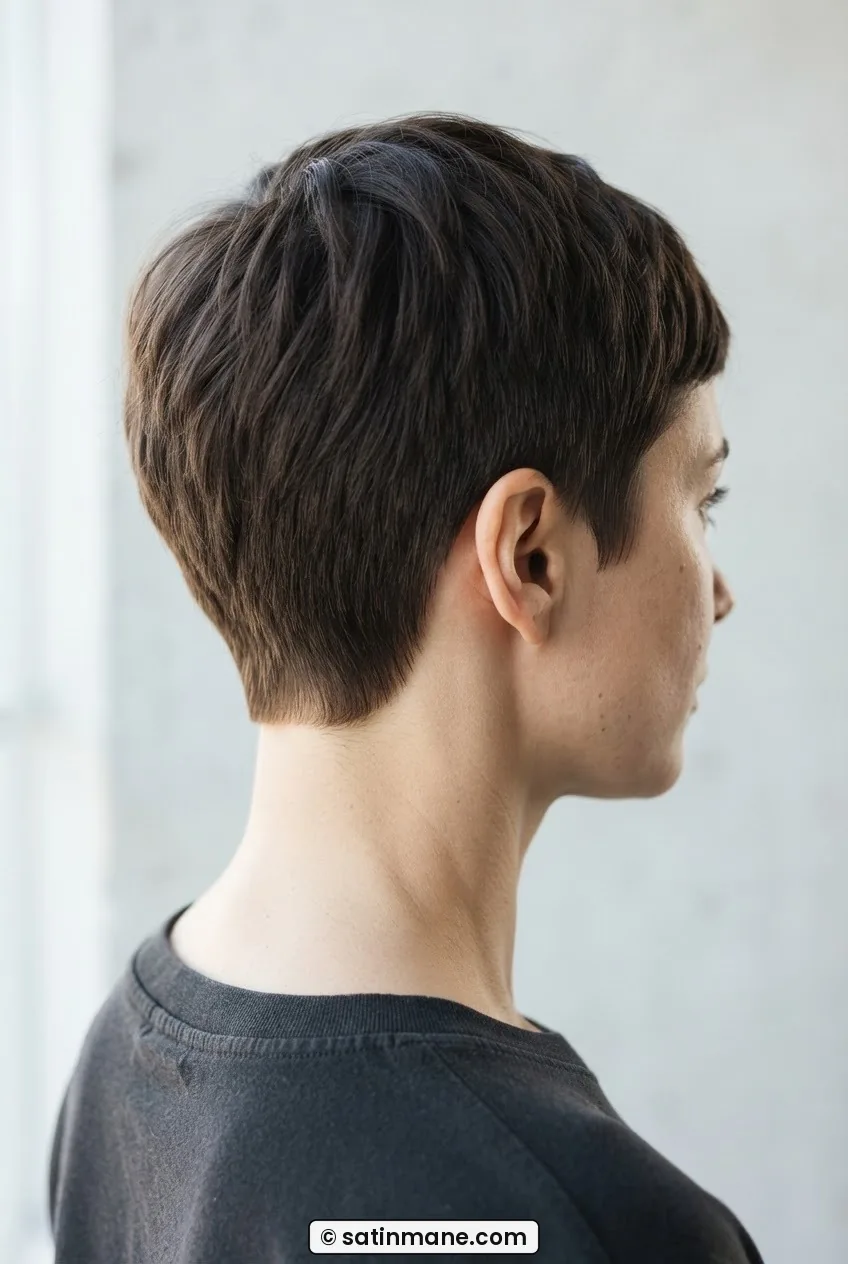
Morning cost on a good cut: run a little pomade or light wax through and you’re done. The hair behaves because the density has been properly managed at the cutting stage. Managing thick hair in a pixie becomes a non-issue when the weight distribution is right from the start.
At the chair, say: “My hair is thick — I need interior density removed through slide-cutting, not just a shorter perimeter. Keep the silhouette tight, tapered nape, and razor-finish the edges.”
10. The One With Forward-Swept Fringe
The crown section is graduated forward rather than upward, so the fringe falls toward the face — sometimes just grazing the brow, sometimes sitting above it, but always moving toward the forehead rather than being swept away from it. The sides and back are cut close. The fringe is the focal point and it’s cut with a slight curve to follow the hairline rather than a straight horizontal line.
This is a soft, face-framing shape — quite different from the structured side-part look or the elevated crown shapes. It suits heart-shaped and oval faces especially well because the fringe draws the eye downward and inward rather than adding width at the sides. Women over fifty who are considering shorter cuts often gravitate to this shape because it’s flattering without being severe — there’s more detail on that in the roundup of short haircuts for women over 50 if you want to see it alongside other options.

The only thing forward-swept fringe asks of you is that you don’t let it grow past the brow line without a trim — at that point it starts falling into your eyes and the whole shape reads longer than intended. Six-week trim schedule, at minimum.
At the chair, say: “Graduate the crown section forward so the fringe falls toward the face, cut with a slight curve, sides close — I want the fringe to be the main feature, not the sides or nape.”
11. The One That Grows Out Gracefully
This is less a specific silhouette and more a specific cutting intention — and it’s worth naming separately because it changes the decisions at the chair. A pixie built to grow well has softer graduation rather than hard disconnection, a nape that’s tapered rather than shaved, and perimeter lengths that move through each other gradually. There are no sharp ledges where the growing-out hair creates an obvious awkward transition.
If you’re on the fence about whether a pixie is really what you want long-term, this is what I’d ask for. You get the short cut, but if you decide to grow it out at month four, you’re not starting from a shaved undercut that takes eighteen months to catch up. The cut grows through its stages looking more like a deliberate short crop, then a longer pixie, then a short shag — rather than a mess. The detail on that in-between phase is genuinely useful reading: the guide to hairstyles for growing out a pixie covers exactly this territory.
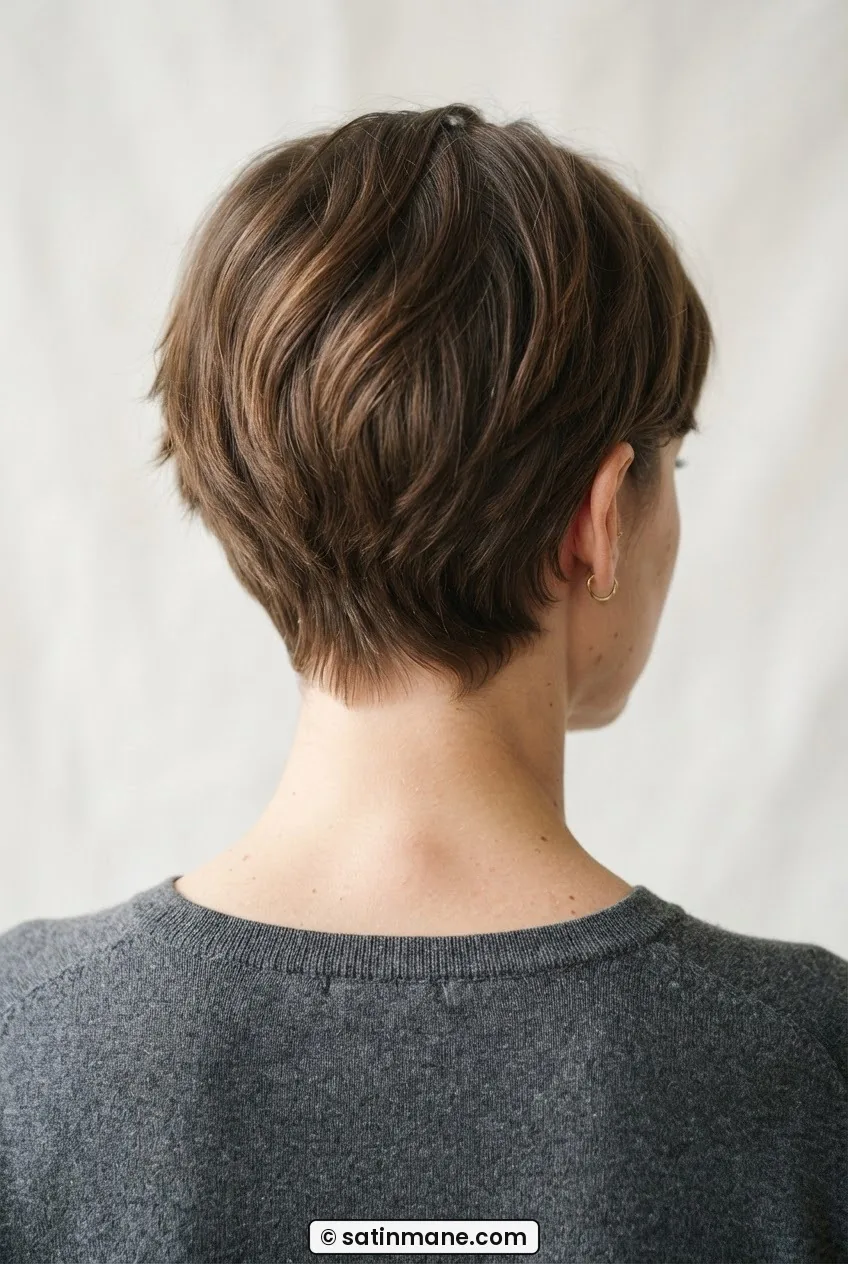
Morning cost: low throughout. The whole point is that nothing is extreme enough to look wrong when it grows. At the chair, say: “I want a pixie built to grow out well — soft graduation, tapered nape rather than shaved, no hard disconnections. Assume I might want to keep growing it in six months.”
Questions I Get About This
How often do short pixie haircuts actually need to be trimmed?
It depends entirely on the shape. A tapered nape or undercut needs tidying every three to four weeks or it looks unintentional. A softer, blended pixie built to grow gracefully can go six to eight weeks. The shapes with the hardest lines — disconnected undercuts, shaved parts — are the highest maintenance, full stop.
Can I ask for a pixie that doesn’t need daily styling?
Yes — and the key is specifying that at the chair so the cut is built for it. A flat-lying pixie with blunt internal cutting and no graduation needs almost no intervention after towel-drying. The textured crown shapes also air-dry well if your natural texture does any of the work. The shapes that always need daily effort are the asymmetric or disconnected styles where the intention is only visible when the longer side is placed deliberately.
Does face shape actually matter that much for a pixie?
It matters in terms of where the volume sits, not whether you “can” have the cut. A round face benefits from height at the crown and close sides — that’s a construction decision the stylist makes, not a reason to avoid the cut entirely. Oval faces can pull off almost any of these shapes. Square faces work beautifully with soft fringe or textured crowns that break up the angularity. The shapes built for specific face geometries are in this list for that reason.
What should I actually say to my stylist to avoid getting a cut I hate?
Use construction language, not mood words. “I want something edgy” tells them nothing useful. “I want a tapered nape, close sides, and a blunt crown with no layers” tells them exactly what to build. Every entry in this list ends with a specific phrase you can use at the chair — take a screenshot of whichever one fits and read it out loud if you have to. No shame in that at all.
Eleven cuts, all of them different in the ways that actually matter — not different in adjectives, but different in where the scissors went and what that means for your mornings. If you’re still deciding, start with what you want the back to do: taper, blend, disconnect, or just grow. That one decision narrows this list to three or four options fast. And then go find someone who can actually execute it, because even the lowest-maintenance shape on this list is only low-maintenance when it’s cut well.