










I have frizzy hair, and I have spent years blaming myself for it — the wrong products, the wrong technique, the wrong prayers to the humidity gods. It took me a very long time to realise the actual problem was the cut. Some shapes work with frizz. Others are basically kindling for it. So I organised everything I know — and everything my stylist has drilled into me — by weather condition, because that is the real variable nobody talks about.
Dry day, humid day, rain, wind: here are 11 frizzy hair hairstyles ranked by how much chaos they can actually handle.
What’s In This Guide to Frizz-Proof Cuts
- On a Dry Day
- 1. The Blunt Collarbone Bob
- 2. The Soft Pixie With Tapered Sides
- 3. The Curtain-Bang Lob
- 4. The Wolf Cut (For Thick, Frizzy Hair)
- At Seventy Per Cent Humidity
- 5. The Textured Shag
- 6. The Long Layers With a Centre Part
- 7. The Curly Bob
- In Actual Rain
- 8. The Buzz-Blended Undercut
- 9. The Stacked Bob
- 10. The Cropped Curl
- In Wind
- 11. The Asymmetric Pixie
- The Condition Nothing Survives
On a Dry Day
A dry day is frizzy hair’s version of a free pass. You still need a cut that complements your texture rather than fighting it, but you have a little room to breathe. These four work beautifully when the humidity is below fifty per cent — which, depending on where you live, might only be about forty days a year. But still. Cherish them.
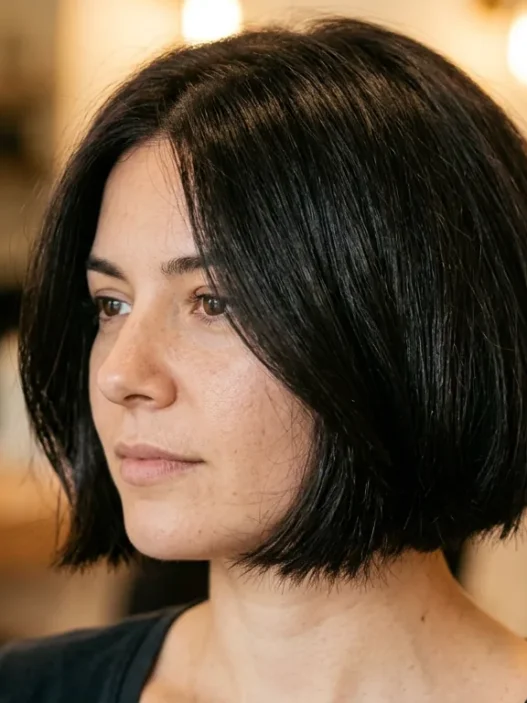
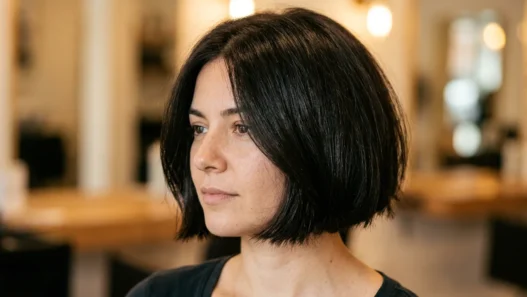
1. The Blunt Collarbone Bob
This is the one I always come back to when I want something that looks intentional with minimal effort. A blunt cut at collarbone length creates a clean perimeter — and a clean perimeter is everything when your hair wants to expand rather than fall. The weight of the blunt line keeps frizzy straight or wavy hair from puffing outward at the ends.
The key word here is collarbone. Shorter and the blunt line can start to read boxy on thicker hair. Longer and you lose the tension that makes the cut work. Right at the collarbone, the hair has enough weight to drape without enough length to go rogue at the tips. Ask your stylist for point-cut ends rather than a perfectly even scissor line — it gives the blunt shape movement without sacrificing the clean edge.

If you have a square face shape, this length is particularly good — the weight line sits right at the softening zone of the jaw and chin.
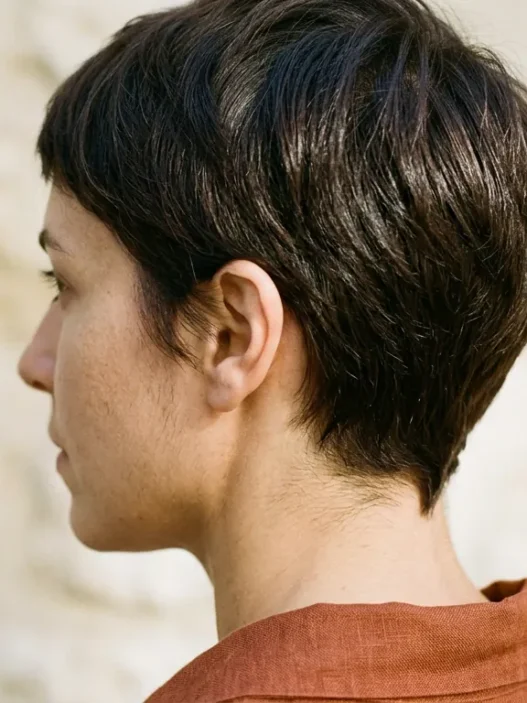
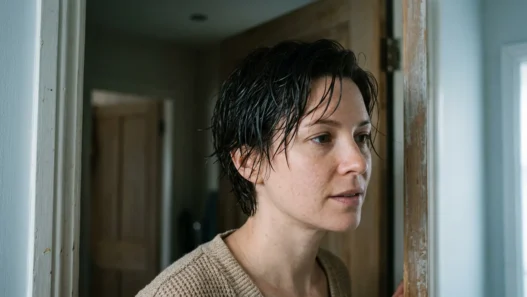
2. The Soft Pixie With Tapered Sides
Short hair and frizzy hair seem like a contradiction — but they’re not. A soft pixie with tapered sides works precisely because it removes the length where frizz builds. The sides taper close to the head, which means the most humidity-sensitive area of your hairline has almost nothing to lift. The top stays slightly longer, which is where your texture can actually show up in a beautiful way rather than a chaotic one.
She has a very similar texture to mine in the photo — see how the crown has this nice lived-in volume without looking untamed? That’s the tapered sides doing the structural work. On a dry day this cut barely needs product. A small amount of pomade or a curl cream pressed through the top and you’re out the door.

The honest caveat: you’re back in the chair every six to seven weeks, minimum. If that schedule doesn’t appeal to you, read what I wrote about short hairstyles for women — what nobody tells you first, because the maintenance commitment is real.
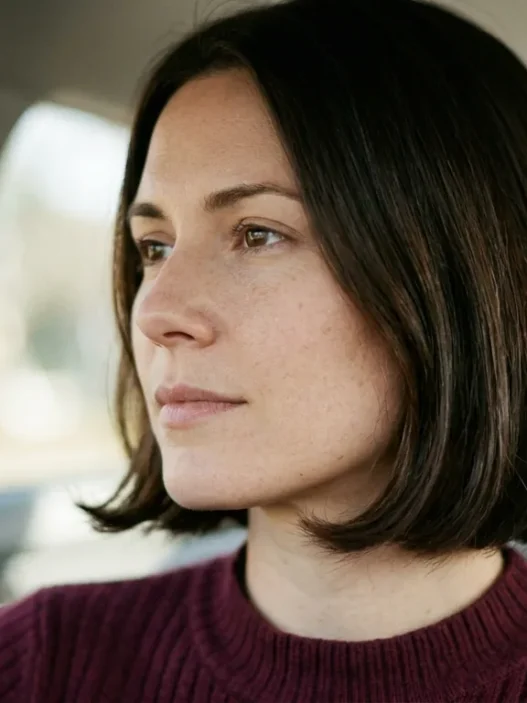
3. The Curtain-Bang Lob
Curtain bangs and frizzy hair sound like a disaster. But hear me out. When cut correctly — long, starting from behind the front hairline, parted at the centre and left to blend into the length — curtain bangs actually frame the face in a way that draws the eye away from any texture variation on the rest of the hair. The lob (long bob, sitting just below the shoulder) gives the body of the hair enough weight to hang without puffing.
On a dry day, I love this cut because the fringe dries relatively flat and the length just… does its thing. No diffuser required. A little smoothing serum through the mid-lengths and a quick finger-press on the parting and this genuinely qualifies as a wash-and-go on the right day.

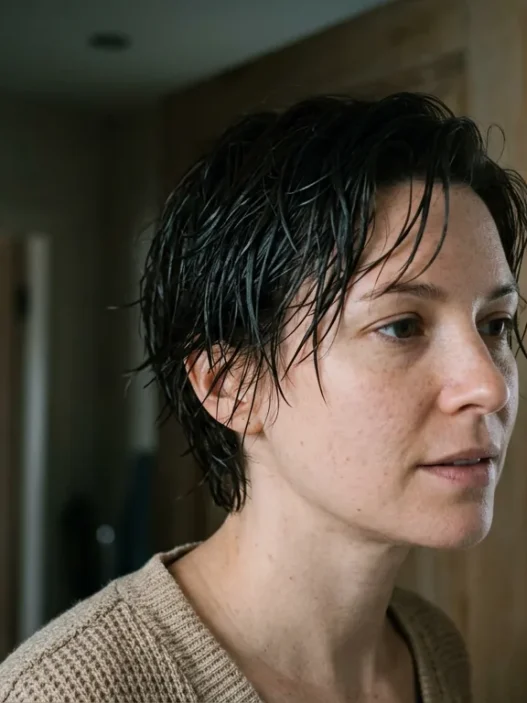
4. The Wolf Cut (For Thick, Frizzy Hair)
The wolf cut gets a lot of hype, and most of it is warranted — but specifically for thick, frizzy hair. If your hair is fine, this cut will eat you alive. But if you have dense, coarse hair that builds into a pyramid by 11am, the wolf cut’s heavy internal layers remove bulk from exactly the right places: mid-shaft, where the weight sits, while leaving length at the ends for swing.
The shaggy face-framing pieces around the front soften the shape so that when the rest of the hair does its frizzy thing, it reads as intentional texture rather than neglect. My stylist describes this as giving frizz a “container” — the shape holds even when the individual strands don’t behave. On a dry day it’s genuinely gorgeous. It does require learning how to diffuse properly if you want the layers to land where you put them, but once you have that down it’s a good time.

At Seventy Per Cent Humidity
This is where things get real. Seventy per cent humidity is the everyday reality for huge swathes of the world, including most of the UK between May and September, coastal Australia, the entire American southeast, and basically everywhere near water. At this level your hair is actively pulling moisture from the air. The cuts that work here are ones that are engineered to swell predictably — not to resist swelling, which is a losing battle.
5. The Textured Shag
The textured shag might be the single most forgiving haircut ever invented for frizzy hair in humid conditions. Here’s why: it’s built on the assumption that your hair has personality. The layers are cut to enhance movement, not suppress it. When humidity hits and your strands start doing their own thing, the shag’s structure means they’re doing it within a framework that looks deliberate.

Chunky layers through the back, shorter pieces around the face, and a slightly disconnected feel at the ends. This cut is brilliant at medium length — roughly shoulder to just past collarbone — because there’s enough weight to hold the shape without so much length that the hair becomes a frizz sail. The best cuts for thick frizzy hair will almost always come back to a variant of this shape. I am not even slightly surprised.
6. The Long Layers With a Centre Part
This is my personal pick for anyone who refuses to cut their hair short but still wants humidity to stop winning. Long layers with a centre part are the closest thing I have found to a compromise — you keep the length, you get the weight distribution that controls the frizz, and the centre part means the hair falls in two organised curtains rather than one unpredictable cloud. I wore this cut for two years and it genuinely changed my relationship with my hair.
The long layers need to start high — around the cheekbone, not at the shoulder — so that the weight is distributed across the entire length rather than sitting in one heavy lump at the bottom. If the layers start too low, you lose the frizz-taming benefit entirely. At seventy per cent humidity this cut benefits enormously from a leave-in conditioner applied to damp hair before air-drying. The centre part does a lot of work keeping the shape coherent as it dries.

7. The Curly Bob
If your frizzy hair is also curly or wavy — and the two often go together — the curly bob deserves serious consideration. Cut dry, with the curls in their natural state, this bob lands at a length that suits your individual shrinkage. That’s the important part: it’s not a standard bob that happens to be cut on curly hair. It’s a bob designed around the curl pattern, so the shape is correct after drying rather than before.
At high humidity, the curly bob actually improves. More moisture in the air means more curl definition, and the bob’s short-ish perimeter means there isn’t enough length to collapse under its own weight. Look at how she’s wearing hers in the photo — the curls have some real texture to them and the whole thing just looks like that’s the plan. Because it is.

In Actual Rain
Right. Rain. This is where we separate the cuts that are merely humidity-tolerant from the ones that are genuinely waterproof in any meaningful hair sense. In rain, you’re not just managing moisture in the air — you’re managing water landing directly on your hair and then evaporating unevenly. The shape has to survive getting wet.
8. The Buzz-Blended Undercut
Not for everyone — genuinely not. But for anyone who has thrown their hands up entirely at managing frizzy hair in wet weather, the buzz-blended undercut is worth considering. The underneath is clipped very short (think a grade two or three), and the top is left longer to style as you choose. When it rains, the underside dries in seconds. The top can be slicked back, pinned up, or left to do its textured thing — and “its textured thing” has nowhere near enough length to become a true frizz situation.

The people I know who’ve gone this route describe it as “finally feeling like my hair is on my team.” She’s got the undercut shown here with the top twisted loosely back — see how clean the silhouette is even with visible texture? That’s exactly the point.
9. The Stacked Bob
The stacked bob is a bob that’s cut shorter at the nape and stacked with graduated layers up the back of the head, so the silhouette rounds and lifts at the crown. In rain, this works because the shortest, most frizz-prone sections — the nape and the area around the ears — are cut to a length where frizz genuinely cannot build. The top and front are long enough for styling but short enough to dry relatively quickly.
This is a brilliant cut for women with round faces too, because the stacking at the crown adds height and the shorter sides don’t add width. Two problems solved simultaneously. I always appreciate a cut that multitasks.

10. The Cropped Curl
Very short. Very curly. Utterly rain-immune. The cropped curl — sometimes called a TWA (teeny weeny afro) or a curl-friendly crop, depending on your curl type — is the cut that makes rain irrelevant rather than survived. You get wet. The curls spring up. They dry. You look great. There is no frizz story because there is not enough length for frizz to write one.
If you’ve been nervous about going this short, there’s genuinely useful territory covered in a guide about growing out a pixie that also talks through what short-to-medium transition looks like — because the fear of being stuck is real, and knowing the exit ramp helps you make the decision more clearly.

In Wind
Wind is its own category because it does something none of the others do: it tangles. Frizzy hair that tangles in wind ends up matted at the ends and knotted at the nape, and by the time you’re inside again the shape of your cut is completely gone. Cuts that work in wind are either short enough to not catch it, or structured enough to reassemble after it.
11. The Asymmetric Pixie
The asymmetric pixie is slightly longer on one side than the other — sometimes just a centimetre or two of difference, sometimes quite dramatic. In wind, this works for two reasons. First, there’s barely enough length to tangle. Second, the deliberate asymmetry means that when the wind moves the hair, it moves it in a direction the cut already anticipates. There’s no “wrong” side after wind. The shape reassembles because it’s built to look slightly dishevelled by design.

If you’ve been curious about pixies but find a lot of advice around them either too vague or suspiciously enthusiastic, the more grounded take on short hairstyles for women with fine hair is worth reading even if your hair is thick — the section on what a crop actually demands day-to-day applies to everyone.
The Condition Nothing Survives
A ninety-per-cent humidity day in actual heat — the kind where the air feels like a warm wet towel and you’re sweating by the time you’ve walked to the car. Nothing survives this. Not a silk press. Not a fresh blowout. Not a prayer. At this point the only honest answer is a bun, a braid, or acceptance. But here’s the thing: if your cut is working correctly, even your bun looks good. The shorter pieces around the face frame things nicely, the texture at the nape gives the updo a lived-in quality that reads as intentional, and you just… go about your day.
The whole point of finding the right cut for frizzy hair isn’t to defeat frizz. It’s to have a shape that’s still coherent when frizz shows up — because it always will. The cuts above are my best answer to that, organised by the conditions that actually matter. I hope they help you fight fewer losing battles and start planning for the weather instead.
What Women With Frizzy Hair Ask Before Booking a Cut
Should frizzy hair be cut wet or dry?
Ideally dry, or at least partially dry — especially if your hair is curly or wavy. Cutting wet hair on frizzy textures often leads to a length that surprises you once it dries, because shrinkage is unpredictable. Ask your stylist if they can do the final shaping on dry hair.
Do layers make frizzy hair worse?
They can, but it depends entirely on where the layers are placed. Short, thin layers cut close to the face on frizzy hair create flyaways with nothing to hold them down. Heavy, long layers cut through the interior of the hair — rather than the surface — are usually the opposite: they reduce bulk and help the shape hold through humidity. The technique matters as much as the decision to layer at all.
Can a haircut alone control frizzy hair without products?
Somewhat, but not completely. The right cut dramatically reduces how much product you need and how often you need to intervene. A structurally good cut for your texture means you’re working with the hair rather than against it. But in high humidity, even the best cut benefits from a small amount of curl cream or anti-frizz serum worked through damp hair before air-drying.
How often does frizzy hair need to be trimmed?
More often than you probably want to hear. Every eight to ten weeks is realistic for most frizzy textures — not because frizzy hair grows faster, but because split ends and irregular ends make frizz significantly worse. A trim that keeps the perimeter clean is the single most effective maintenance step for frizz-prone hair.